Metrics library
- Realized cap: valuing coins at the price they last moved
- Realized price: the average price coins last moved at
- MVRV ratio: market value compared with realized value
- NVT ratio: network value compared with on-chain volume
- NUPL: how much paper profit or loss the network holds
- SOPR: are coins being spent at a profit or a loss?
- Percent supply in profit: how many coins are above water
- HODL waves: reading Bitcoin’s supply by coin age
- Coin Days Destroyed: measuring when old bitcoin starts to move
- Hash rate: how much work is securing Bitcoin
- Active addresses: counting who used the chain — roughly
- Puell Multiple: is miner income high or low compared with the past year?
- Exchange netflow: coins in minus coins out
- Stablecoin supply ratio (SSR): Bitcoin’s size against the stablecoin pile
- Funding rate: the price of staying long or short in perpetual futures
- Open interest: how much leveraged exposure is open right now
Exchange netflow: coins in minus coins out
Netflow tracks whether more coins arrived at exchange wallets than left them. The subtraction is trivial; deciding which wallets belong to exchanges is where the uncertainty lives.

Photo: “Free airport departure board image” by Unknown, CC0 1.0, via Rawpixel (edited: cropped and resized).
Exchange netflow is the net amount of a coin sent to or withdrawn from exchange addresses in a period: inflow minus outflow [1]. Positive means coins accumulated on exchanges; negative means they left. Because exchange addresses are identified by labelling and clustering, the figures are estimates [2].
Key points
- 1Netflow = coins sent to identified exchange addresses − coins withdrawn from them, per period.
- 2For Bitcoin, deposits and withdrawals inside the same transaction are netted first.
- 3Only labelled exchanges are covered, and labels are revised as new addresses are found.
- 4A positive or negative reading describes movement. It does not reveal why coins moved.
What does exchange netflow measure?#
Coin Metrics defines netflow as the net amount of native units sent to or withdrawn from an exchange during the interval [1]. Coins count as sent to an exchange when they go to an address the provider identifies as exchange-owned, and as withdrawn when they leave the control of such an address [1]. Netflow is the difference between the two, usually published per exchange and per day.
Netflow = Inflow to exchange addresses − Outflow from exchange addressesA dollar version multiplies the native-unit netflow by the day’s price [1]. Exchange supply — the balance on all of an exchange’s hot and cold wallets — changes by roughly the netflow each day [3].
For Bitcoin, Coin Metrics removes the effect of change outputs before counting. If one transaction sends 90 BTC to exchange A and also withdraws 50 BTC from it, the recorded flow is +40 BTC rather than +90 and −50 [1]. Change outputs appear in most Bitcoin payments because outputs must be spent in full [4].
How is netflow calculated across several exchanges?#
| Step | Value |
|---|---|
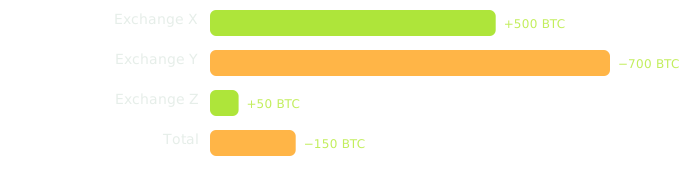
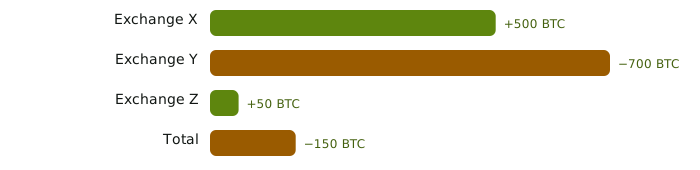
| Exchange X: 2,400 in − 1,900 out | +500 BTC |
| Exchange Y: 800 in − 1,500 out | −700 BTC |
| Exchange Z: 300 in − 250 out | +50 BTC |
| Total = 500 − 700 + 50 | −150 BTC |
| Total in dollars = −150 × $60,000 | −$9,000,000 |
Two of three exchanges gained coins, yet the total is negative. Headlines about “exchange outflows” usually describe a total like this, which can hide very different movements at individual exchanges.
Per-exchange netflow in the example
Transfers between exchanges add a twist. If exchange X sends 100 BTC to exchange Y and both are labelled, X shows −100 and Y +100, which cancel in a total that adds up the exchanges. If Y’s address is not labelled, the same transfer shows up only as a 100 BTC outflow from X — a movement between two exchanges that looks like coins leaving exchanges altogether.
How do analysts read exchange netflow?#
There is no rule that links netflow to price. The common interpretation is a hypothesis: coins generally need to be on an exchange to be sold there, so persistent positive netflow is often read as supply being made available to sell, and persistent negative netflow as coins moving into self-custody. Use that as a question to investigate, not an answer.
| Reading | Common interpretation | Also consistent with |
|---|---|---|
| Persistent positive netflow | More coins available to sell | Collateral deposits, exchange consolidating wallets |
| Persistent negative netflow | Coins moving to self-custody | Moves to unlabelled cold storage or custodians |
| One very large print | A single big holder acting | Internal reshuffle not yet recognised by the provider |
| Near-zero netflow, high gross flows | Busy but balanced deposit and withdrawal traffic | Many users cycling coins in and out |
What are the limits of exchange netflow?#
- Lower bounds. Coin Metrics calls its exchange supply an underestimate because its heuristics may not find every exchange address [3]; Glassnode says its balances can largely be treated as lower bounds [2].
- Coverage. Each provider covers a specific list of exchanges and chains, and may withhold a metric where coverage is incomplete [1].
- Revisions. Newly labelled addresses can change past values; point-in-time data exists to keep the originally published numbers [5].
- Off-chain blind spot. Trading between customers inside an exchange never touches the chain and is excluded from on-chain exchange metrics [2].
For a fuller beginner walk-through with a week of flows, read exchange inflows and outflows explained. The general problem of labels is covered in the limits of on-chain data.
Exchange netflow in one box
What mistakes do beginners make here?#
- Reading positive netflow as “people are selling”
It means coins arrived at labelled addresses. Selling is one possible reason among several.
- Ignoring per-exchange detail
A negative total can hide large inflows at some exchanges. Check the breakdown before drawing conclusions.
- Treating history as fixed
New labels revise past values. Note the date you pulled the data.
- Comparing providers directly
Different address lists give different numbers for the same exchange and day.
Frequently asked questions#
What is the difference between netflow and exchange balance?
Netflow is the change over a period; exchange balance is the stock held at the end of it. Coin Metrics defines exchange supply as the amount held by an exchange at the end of the interval [3].
Why does netflow differ between data providers?
Each provider identifies exchange addresses with its own mix of disclosed addresses, public tags and clustering [2], so their coverage differs.
Does negative netflow mean the price will rise?
No. It describes coins leaving labelled exchange wallets. Price depends on many things the blockchain does not record.
Can netflow be measured for any exchange?
Only for exchanges whose addresses a provider has identified. Exchanges that publish verified addresses tend to be covered more accurately [2].
The bottom line#
Exchange netflow is simple arithmetic on top of a hard labelling problem. It can show whether coins are accumulating on or leaving the exchanges a provider tracks, but the figures are lower-bound estimates, can be revised, and say nothing about motive.
Related flows and positioning data live in the derivatives and stablecoin metrics: see stablecoin supply ratio and open interest.
Sources#
Grade A = primary source (regulator, protocol specification, client code, original author). Grade B = expert secondary source used for explanation only.
- BCoin Metrics Data Knowledge Base. Net Flows (exchange metrics), 2026.
- BGlassnode Docs. Exchange Data Transparency Notice, 2026.
- BCoin Metrics Data Knowledge Base. Exchange Supply (exchange metrics), 2026.
- Abitcoin.org developer documentation. Developer Guide: Transactions, 2026.
- BGlassnode Docs. Point-in-Time Metrics, 2026.