Metrics library
- Realized cap: valuing coins at the price they last moved
- Realized price: the average price coins last moved at
- MVRV ratio: market value compared with realized value
- NVT ratio: network value compared with on-chain volume
- NUPL: how much paper profit or loss the network holds
- SOPR: are coins being spent at a profit or a loss?
- Percent supply in profit: how many coins are above water
- HODL waves: reading Bitcoin’s supply by coin age
- Coin Days Destroyed: measuring when old bitcoin starts to move
- Hash rate: how much work is securing Bitcoin
- Active addresses: counting who used the chain — roughly
- Puell Multiple: is miner income high or low compared with the past year?
- Exchange netflow: coins in minus coins out
- Stablecoin supply ratio (SSR): Bitcoin’s size against the stablecoin pile
- Funding rate: the price of staying long or short in perpetual futures
- Open interest: how much leveraged exposure is open right now
Active addresses: counting who used the chain — roughly
Active addresses is one of the oldest on-chain metrics and one of the easiest to misread. It counts addresses, not people, and the gap between the two can be large.

Photo: “Post Office boxes” by michael clarke stuff, CC BY-SA 2.0, via Flickr (edited: cropped and resized).
Active addresses is the number of unique addresses that sent or received coins during a period, each counted once [1]. It is a popular proxy for network users, but one person can control many addresses, and where addresses are cheap the count can be inflated [1].
Key points
- 1An address is counted once per period if it appears as a sender or recipient of any ledger change.
- 2Variants count only senders, only recipients, or only addresses moving more than a dollar threshold.
- 3Addresses are not users: privacy practice spreads one person across many addresses, while exchanges pool many people into few.
- 4Use the trend of a smoothed series from one provider; avoid comparing absolute counts across chains.
What exactly is an active address?#
An address is the destination written into a transaction. Coin Metrics defines active addresses as the count of unique addresses that were active in the network — as a recipient or as an originator of a ledger change — during the period, with no double counting [1]. A ledger change is broader than a payment: depending on the chain it can include claiming mining or staking rewards, voting, or creating accounts [1].
The rules are deliberately inclusive. An address counts even if it sends zero coins, sends coins to itself, or takes part in a failed transaction on Ethereum; the null (issuance) address is excluded [1]. Daily, weekly and monthly versions exist; in each, an address active several times in the window still counts once.
Active addresses (period) = number of distinct addresses appearing as sender or recipient in any ledger change during the periodVariants restrict the set: senders only, recipients only, or only addresses with at least one transfer above a USD threshold such as $1 [1].
How is the count worked out in practice?#
| Step | Value |
|---|---|
| Block reward of 3.125 coins paid to A | A receives ($187,500) |
| B sends 0.01 to C and 0.01 to D | B sends; C, D receive ($600 each) |
| C sends 0.005 back to B | C sends; B receives ($300) |
| E sends 0.2 to itself | E sends and receives ($12,000) |
| F sends 0.00001 to G | F sends; G receives ($0.60) |
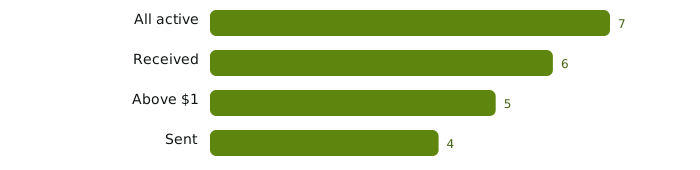
| Active addresses (A, B, C, D, E, F, G) | 7 |
| Active addresses, sent only (B, C, E, F) | 4 |
| Active addresses, received only (A, B, C, D, E, G) | 6 |
| Addresses with a transfer above $1 (A–E) | 5 |
Sent and received counts overlap, so they do not add up to the total. Note that E’s self-send counts as activity, and F and G drop out of the $1 version because their only transfer was worth $0.60.
Periods are not additive either. If the same seven addresses were active every day for a week, the daily counts would sum to 49, but the weekly active-address figure would still be 7 — because each address is counted once per window [1].
How do analysts read active addresses?#
Coin Metrics describes active addresses as a popular measure to proxy the number of users, and notes that it is typically less sensitive to stress tests than transaction counts [1]. Analysts mostly use it as a trend: a sustained rise in a smoothed series suggests more participants or more activity per participant; a sustained fall suggests the opposite. Which of those it is cannot be read from the metric alone.
| What you see | Reasonable reading | What it does not tell you |
|---|---|---|
| Steady rise over months | Broader or busier use of the chain | How many new people — one user can add many addresses |
| Sudden one-day spike | Possibly a burst of activity | Whether it is spam, an airdrop or a batch of exchange payouts |
| Fall while price rises | Activity and price moving apart | That either one will reverse |
| Chain A above chain B | Very little on its own | Relative users — address costs and designs differ |
Same day, four ways to count

Why is an address not a user?#
Bitcoin’s design pushes people towards many addresses. The whitepaper recommends a new key pair for each transaction to stop payments being linked to a common owner [2], and the developer guide recommends new addresses for change outputs too [3]. A careful user can show up as several active addresses in a single day. In the other direction, an exchange can move coins for thousands of customers through a handful of addresses.
On account-based chains the problem has a different shape. Creating an Ethereum externally owned account costs nothing [4], and Coin Metrics warns that where creating addresses and transacting are cheap or free, active addresses can be trivially forged [1]. That is why the dollar-threshold variants exist: they ignore dust-sized transfers that cost almost nothing to fake. The broader issue is covered in the limits of on-chain data.
Which chains does the metric work on?#
Active addresses can be computed for any chain whose transactions are public, but the definitions shift with the chain. Coin Metrics notes chain-specific rules — for Solana it counts owner accounts and sub-accounts — and does not publish the metric for assets with full privacy such as Monero and Grin [1]. Compare a chain with its own history; cross-chain comparisons of absolute counts mix different designs and costs. For a UTXO-versus-account primer, see UTXO vs account model.
Active addresses in one box
What mistakes do beginners make here?#
- Equating addresses with users
Privacy practice multiplies addresses per person, and exchanges pool many people into few addresses.
- Adding daily counts to get a weekly figure
An address active every day counts once in the weekly figure, so daily counts overstate weekly activity when summed.
- Comparing chains by raw counts
Cheap address creation on one chain and costly transactions on another make absolute comparisons meaningless.
- Chasing single-day spikes
Spam, airdrops and batched payouts can create sudden jumps. Use a 7-day or 30-day average.
Frequently asked questions#
Does sending coins to myself count as activity?
Yes. Coin Metrics counts any active address, including one sending coins to itself or sending zero coins [1].
Why do providers show different numbers?
They differ on which ledger changes count, whether dust is filtered and how windows are defined. Pick one provider and compare its series with itself.
Is a rising number of active addresses bullish?
Not by itself. It describes activity, and activity often follows price. It is not a buy or sell signal.
What is the difference between active addresses and new addresses?
Active addresses counts every address that participated in the period. New addresses counts only those appearing for the first time.
The bottom line#
Active addresses gives a quick, transparent sense of how busy a chain is, built from simple counting rules. Its weakness is the gap between addresses and people, which privacy practice, exchanges and cheap address creation can widen in either direction.
For a less forgeable view of activity, compare it with how much supply actually moves in coin days destroyed, and for mining-side activity see hash rate.
Sources#
Grade A = primary source (regulator, protocol specification, client code, original author). Grade B = expert secondary source used for explanation only.
- BCoin Metrics Data Knowledge Base. Active Addresses (network data definitions), 2026.
- ASatoshi Nakamoto. Bitcoin: A Peer-to-Peer Electronic Cash System, 2008.
- Abitcoin.org developer documentation. Developer Guide: Transactions, 2026.
- Aethereum.org. Ethereum accounts, 2026.