UTXO (unspent transaction output)
Your bitcoin “balance” is really a collection of separate pieces, each left over from a past transaction. Each piece is a UTXO.
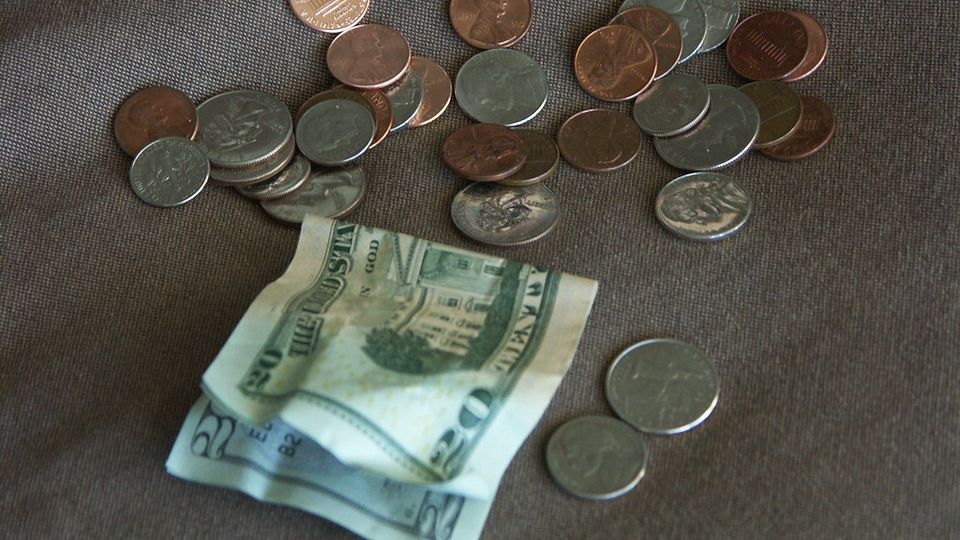
Photo: “Currency” by hsivonen, CC BY 2.0, via Flickr (edited: cropped and resized).
A UTXO (unspent transaction output) is an amount of bitcoin a past transaction sent you that has not been spent yet [1]. Your balance is the sum of your UTXOs. Spending one uses it up entirely; any surplus comes back as a new change output [2].
Key points
- 1Bitcoin tracks individual unspent outputs, not account balances.
- 2A UTXO can be spent only once, and only as a whole.
- 3Paying less than a UTXO’s value creates a change output back to you; the fee is whatever is left over.
How does a UTXO work?#
Every Bitcoin transaction has inputs and outputs. Each input spends an output from an earlier transaction, and each new output then waits as an unspent transaction output until a later input spends it. Bitcoin’s developer guide puts it plainly: when a wallet shows a balance of 10,000 satoshis, it means 10,000 satoshis are waiting in one or more UTXOs [2].
Glassnode compares UTXOs to cash. $50 in your pocket might be one $50 note or five $10 notes; the total is the same. And just as you cannot tear a piece off a banknote, you cannot send part of a UTXO — you hand over the whole thing and get change [3]. Unlike notes, though, UTXOs can be any amount, and fees come out of what would otherwise be your change [3].
| Step | Value |
|---|---|
| UTXO A | 300,000 sats |
| UTXO B | 200,000 sats |
| Inputs used = A + B | 500,000 sats |
| Output 1: payment to the shop | 400,000 sats |
| Fee to the miner (hypothetical) | 2,000 sats |
| Output 2: change back to you = 500,000 − 400,000 − 2,000 | 98,000 sats |
After this transaction, A and B are spent forever. The shop now holds a new 400,000-sat UTXO and you hold a new 98,000-sat one. The fee is not a separate output: it is simply inputs minus outputs, which the miner may claim [4].
How is a UTXO different from an account balance?#
Account-based blockchains such as Ethereum keep a single balance per account, like a bank account, and let you spend part of it directly. If you hold 10 ETH and send 3.75 ETH, you simply have 6.25 ETH left — no change output is needed [3]. Read the full comparison in UTXO vs account model.
Why do UTXOs matter for on-chain analysis?#
Each UTXO carries an amount and a creation time, so analysts can measure how old the coins being spent are. Metrics such as Coin Days Destroyed and HODL waves are built this way. Glassnode warns that change outputs add noise to such metrics, so providers try to identify and adjust for change [3].
Which words are related?#
- Satoshi — every UTXO holds a whole number of satoshis.
- Address — where a UTXO is sent; one address can hold many UTXOs.
- How Bitcoin transactions work — inputs, outputs and signatures step by step.
Frequently asked questions#
Can a UTXO be spent twice?
No. A UTXO can be spent only once; after that it no longer exists and its value lives on in the new outputs [2].
Do I need to manage UTXOs myself?
Usually not. Wallets choose which UTXOs to spend and create the change output automatically. Some wallets also let you choose UTXOs by hand.
Does Ethereum use UTXOs?
No. Ethereum is account-based: balances live in accounts and can be partly spent without change outputs [3].
Sources#
Grade A = primary source (regulator, protocol specification, client code, original author). Grade B = expert secondary source used for explanation only.
- Abitcoin.org developer documentation. Bitcoin Developer Glossary: UTXO, 2026.
- Abitcoin.org developer documentation. Developer Guides: Transactions, 2026.
- BGlassnode Docs. UTXO vs. Account-Based Chains, 2026.
- Abitcoin.org developer documentation. Developer Guides: Block Chain (transaction data), 2026.