Perpetual futures and funding rates: how a contract with no expiry stays near spot
A perpetual future never settles, so something else has to keep its price close to the real coin. That job falls to funding: small, regular payments between traders who are long and traders who are short.

Photo: “Clock gears in the St Maximus church in Magnac-Laval 02” by Krzysztof Golik, CC BY-SA 4.0, via Wikimedia (edited: cropped and resized).
A perpetual future is a derivative with no expiry date. To keep its price near spot, one side pays the other a periodic funding payment: when the contract trades above spot, longs pay shorts; below spot, shorts pay longs [1]. Rates and intervals differ by venue.
Key points
- 1Perpetuals are futures-style contracts that never expire; funding payments replace the settlement date.
- 2Positive funding means longs pay shorts; negative funding means shorts pay longs. The venue only passes the money between traders.
- 3A typical formula combines a premium (perp price vs spot) with a small fixed interest component, within limits set by the venue.
- 4Funding is charged on the full position size, so leverage multiplies its cost relative to your margin.
- 5Every venue sets its own interval, formula and caps. The worked numbers here use Hyperliquid’s published rules; Bybit’s are summarised for contrast.
On this page
- What is a perpetual future?
- How does funding keep the price close to spot?
- How is the funding rate calculated?
- How much does funding actually cost?
- Why do funding rules differ between venues?
- What do positive and negative funding tell you?
- What mistakes do beginners make here?
- Frequently asked questions
- The bottom line
- Sources
What is a perpetual future?#
A traditional futures contract is, in the CFTC’s definition, an agreement to buy or sell something “for delivery in the future” at a price set when the contract starts [2]. That future date is its expiry. On that date it is settled — for most crypto futures in cash, with one side paying the other an amount based on the price of the underlying asset or an index, as the contract specifies [2] [3]. Because of that final settlement, the futures price cannot stray far from spot as expiry nears. A perpetual future — often shortened to “perp” — removes the expiry date. You can hold the position for as long as you keep enough margin.
Without a settlement date, nothing would force the perp to track the coin. The answer is funding. Hyperliquid’s documentation, used on this page as one worked example of how a venue documents its rules, describes its perpetuals as “derivatives products without expiration date” that “rely on funding payments to ensure convergence to the underlying spot price over time” [4].
How does funding keep the price close to spot?#
Funding is a periodic payment from one side of the contract to the other. In Hyperliquid’s words, it “is purely peer-to-peer and no fees are collected on the payments” [1]. If the perp’s price is above the spot (oracle) price, the funding rate is positive and longs pay shorts. If the perp is below spot, the rate is negative and shorts pay longs [1].
How positive funding nudges a perp back toward spot


The venue does not set the price directly. It changes the cost of holding each side. The documentation says that when the funding rate is high, “it can incentivize traders to take the opposite position and help to bring the contract’s price closer to the spot price” [1]. Note the word can: funding is an incentive, not a guarantee, and gaps can persist during fast markets.
How is the funding rate calculated?#
Most formulas have two parts: a premium that measures how far the perp is from spot, and a small interest rate component. On Hyperliquid the interest component is fixed at 0.01% every 8 hours, “paid to short”, which the documentation says represents the difference in cost to borrow USD versus spot crypto [1]. The premium is sampled every 5 seconds and averaged over the hour [1].
Funding rate (8-hour) = Average premium + clamp(Interest rate − Average premium, −0.05%, +0.05%)Clamp means “keep the value between these two limits”. Funding is then paid every hour at one-eighth of this 8-hour rate, and capped at 4% per hour. This is Hyperliquid’s published formula [1]; other venues use their own.
The clamp has a useful side effect. Whenever the premium is within 0.05 percentage points of the 0.01% interest rate, the two cancel out and the funding rate lands exactly on the 0.01% baseline. Funding only moves away from the baseline when the perp drifts further from spot. The table shows this with hypothetical premiums.
| Average premium | 8-hour funding rate | Paid each hour | Who pays |
|---|---|---|---|
| +0.02% (perp slightly above spot) | 0.01% | 0.00125% | Longs pay shorts |
| +0.30% (perp well above spot) | 0.25% | 0.03125% | Longs pay shorts |
| +1.00% (the docs’ own example) | 0.95% | 0.11875% | Longs pay shorts |
| −0.10% (perp below spot) | −0.05% | −0.00625% | Shorts pay longs |
Computed with the formula above: interest rate 0.01% per 8 hours, clamp ±0.05%, hourly payment = 8-hour rate ÷ 8. The 1% row reproduces the numerical example in Hyperliquid’s documentation.
How much does funding actually cost?#
The payment at each interval is the position size × the oracle (spot) price × the funding rate. Hyperliquid stresses that it uses the spot oracle price, “not the mark price”, to convert the position into a dollar amount [1]. Because the payment is on the whole position, not on your margin, leverage multiplies funding costs relative to the money you put up.
| Step | Value |
|---|---|
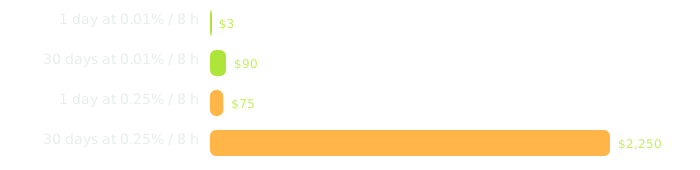
| Baseline rate 0.01% per 8 h: per hour = $10,000 × 0.01% ÷ 8 | $0.125 |
| Baseline: per day (24 payments) | $3.00 |
| Baseline: per 30 days | $90 |
| Elevated rate 0.25% per 8 h: per hour | $3.125 |
| Elevated: per day | $75 |
| Elevated: per 30 days | $2,250 |
| If the $10,000 position used 10x leverage ($1,000 margin): 30 days at the elevated rate | 2.25 times the margin |
If funding were negative by the same amount, the long would receive these sums instead. The baseline 0.01% every 8 hours adds up to 10.95% over a year without compounding; Hyperliquid quotes 11.6% APR, which matches compounding the hourly payment [1].
Funding paid on a $10,000 long, by holding period
Why do funding rules differ between venues?#
Each venue chooses its own interval, caps and premium measure. Hyperliquid says its funding is “designed to closely match the process used by centralized perpetual exchanges” and sets its interest component “for consistency with CEXs” [1], but it pays every hour at one-eighth of the 8-hour rate, and it describes its 4%-per-hour cap as “much less aggressive capping than CEX counterparts” [1]. The premium itself is measured with impact prices — the average price to fill a set dollar amount on each side of the order book — and that amount is 20,000 USDC for BTC and ETH and 6,000 USDC for other assets on Hyperliquid [4].
The exchange Bybit publishes its own version in its help center [5]. The core looks familiar: an average premium index plus the interest rate, with the interest-minus-premium gap clamped to ±0.05% [5]. The result is then clamped again between an upper and a lower limit. Under normal conditions those limits come from each contract’s initial and maintenance margin rates, and Bybit says it may adjust them temporarily during significant market volatility [5]. Its help page uses an 8-hour interval as its example. When a contract’s funding rate reaches its limit at settlement, Bybit switches that contract to settling once per hour [5].
| Rule | Hyperliquid | Bybit |
|---|---|---|
| Interest component | 0.01% per 8 hours, paid to short | 0.03% per day ÷ (24 ÷ interval in hours): 0.01% on an 8-hour interval; 0% on some pairs |
| Clamp on interest − premium | ±0.05% | ±0.05% |
| How often funding is paid | Every hour, at one-eighth of the 8-hour rate | 8 hours in its example; hourly once a contract hits its funding limit |
| Premium averaging | Sampled every 5 seconds, averaged over the hour | Calculated every minute; later minutes weigh more (on an 8-hour interval, the last of 480 minutes counts 480 times the first) |
| Funding cap | 4% per hour | Set from the margin rates of the lowest risk-limit tier; may be adjusted temporarily |
Each column uses only that venue’s own documentation [1] [5]. Bybit says future updates to its funding limits and settlement frequencies “will be adjusted dynamically without separate announcements” [5], so check the live contract page before relying on any figure here.
The practical lesson: a funding rate quoted on one venue cannot be compared with another until both are converted to the same time period. Our funding rate metric guide shows how to do that conversion.
What do positive and negative funding tell you?#
Funding tells you which side of the perpetual market is paying to keep its positions open. Funding persistently above the baseline means the perp has been trading above spot, so traders have been willing to pay to stay long. Negative funding means the reverse. Small positive readings sitting exactly on the baseline mostly reflect the fixed interest component, not enthusiasm. It is a description of positioning on derivatives venues — not a measure of spot demand, and not a timing signal on its own.
One venue’s funding rules (Hyperliquid, as documented)
What mistakes do beginners make here?#
- Reading funding as a fee to the exchange
On venues that document it this way, funding passes between traders. The exchange earns trading fees, not funding.
- Comparing rates with different intervals
0.01% every 8 hours and 0.01% every hour are very different costs. Convert both to a daily or annual figure first.
- Forgetting that funding scales with position size
Funding is charged on the full notional value. At 10x leverage, the same rate costs ten times more as a share of your margin.
- Treating high funding as a sell signal
High funding shows crowded positioning, not a scheduled reversal. Markets can stay one-sided for long periods.
- Copying one venue’s numbers to another
Caps, intervals, impact sizes and premium formulas differ. Always read the contract specifications of the venue you are looking at.
Frequently asked questions#
Who receives the funding payment?
The traders on the other side. When funding is positive, longs pay shorts; when it is negative, shorts pay longs [1].
Do I pay funding if I close my position before the interval?
Funding is added to or subtracted from the balances of contract holders at each funding interval [1]. If you hold no position at that moment, you neither pay nor receive. Check your venue’s exact timing rules.
Can funding be negative for a long time?
Yes. Negative funding simply means the perp has been trading below spot. Shorts then pay longs for as long as that lasts.
Is funding the same as the interest on a margin loan?
Not exactly. Part of many formulas is a fixed interest component — 0.01% per 8 hours on Hyperliquid [1] — but most of the variation comes from the premium between the perp and spot prices.
Do dated futures have funding?
No. Dated futures converge on spot by settling on their expiry date. Funding exists because perpetuals never expire.
The bottom line#
Funding is the mechanism that lets a futures contract live forever: whoever is on the crowded side pays the other side until the perp’s price comes back toward spot. The arithmetic is simple — position size × spot price × rate — but the rules behind the rate are venue-specific.
Before trading a perp, read its contract specifications, convert its funding to a daily cost, and work out your liquidation price. For the wider picture, start with spot vs derivatives.
Sources#
Grade A = primary source (regulator, protocol specification, client code, original author). Grade B = expert secondary source used for explanation only.
- AHyperliquid Docs. Funding, 2026. Used as one example of how a venue documents funding; other venues differ.
- AU.S. Commodity Futures Trading Commission. Futures Glossary: A Guide to the Language of the Futures Industry, 2026.
- AU.S. Commodity Futures Trading Commission. Customer Advisory: Understand the Risks of Virtual Currency Trading, 2026.
- AHyperliquid Docs. Contract specifications, 2026.
- ABybit Help Center. Introduction to Funding Rate, 2026. Bybit’s own rules for its own contracts (page last updated 2026-05-22); not a statement about other venues.
- AEuropean Supervisory Authorities (EBA, ESMA, EIOPA). EU financial regulators warn consumers on the risks of crypto-assets, 2022.
Keep reading

Spot vs derivatives in crypto: owning a coin vs betting on its price
On a spot market you buy the coin itself. On a derivatives market you trade a contract whose value follows the coin’s price. That one difference changes what you own, what you can lose and which costs you pay.

Open interest and liquidations: how leveraged positions build up and unwind
Open interest counts how many derivative positions are still open. Liquidations are what happens when a leveraged position runs out of margin and the venue closes it for you. Here is how both work, with the arithmetic.

Order books explained: how bids, asks and liquidity set the price you pay
An order book is the list of everyone currently willing to buy or sell, sorted by price. Reading it tells you the spread, how deep the market is, and roughly what a trade of your size will really cost.