Open interest and liquidations: how leveraged positions build up and unwind
Open interest counts how many derivative positions are still open. Liquidations are what happens when a leveraged position runs out of margin and the venue closes it for you. Here is how both work, with the arithmetic.

Photo: “Dominoes falling” by Kurt:S, CC BY 2.0, via Wikimedia (edited: cropped and resized).
Open interest is the total value of derivative positions that are still open, measured at a point in time [1]. A liquidation is a forced close that happens when a trader’s equity falls below the venue’s maintenance margin [2]. Higher leverage puts the liquidation price closer to the entry price.
Key points
- 1Open interest is a stock (positions open right now), not a flow like trading volume.
- 2It rises when new positions open on both sides and falls when positions close; the CFTC counts each open contract once, but some data providers count both sides.
- 3A liquidation is triggered when account equity drops below the maintenance margin, which venues set per asset.
- 4At 10x leverage, a hypothetical long can be liquidated after a move of under 9%; at 40x, after about 1.3%.
- 5Liquidation rules — thresholds, partial closes, backstops — are venue-specific. Read them before trading.
On this page
- What is open interest?
- How do trades change open interest?
- What is a liquidation?
- How is a liquidation price calculated?
- What happens step by step during a liquidation?
- How are open interest and liquidations connected?
- How can a trader reduce the risk of liquidation?
- What mistakes do beginners make here?
- Frequently asked questions
- The bottom line
- Sources
What is open interest?#
Open interest (OI) is the total size of derivative positions that are open and have not yet been closed or settled. The US Commodity Futures Trading Commission (CFTC) defines it as the total number of futures contracts “long or short” that have been entered into and not yet closed by an offsetting trade or settled by delivery [3]. For crypto perpetual futures, DefiLlama measures it in dollars, as the “total notional USD value of outstanding perpetual positions that have not yet been settled or closed, snapshotted at the end of the period” [1]. Notional value means the full size of a position, not the margin posted for it.
Two features make open interest different from trading volume. First, it is a snapshot. DefiLlama stresses that “unlike volume, this is a point-in-time measurement, not a flow” [1]. Volume tells you how much traded during a day; open interest tells you how much is still on the books at the end of it. Second, every position has someone on the other side — funding, for example, is paid “by one side of the contract (either long or short) to the other side” [4] — so total long size and total short size are equal.
How do trades change open interest?#
A trade always has a buyer and a seller. What happens to open interest depends on whether each of them is opening a new position or closing an existing one. Hyperliquid, for example, treats a trade as opening “when the absolute value of the position increases” [5].
| Buyer is… | Seller is… | Open interest |
|---|---|---|
| Opening a new long | Opening a new short | Rises by 1 |
| Opening a new long | Closing an existing long | Unchanged — the position changes hands |
| Closing an existing short | Opening a new short | Unchanged — the position changes hands |
| Closing an existing short | Closing an existing long | Falls by 1 |
Measured in dollars, open interest also moves with price: the same number of contracts is worth more when the price rises, even if nobody trades.
That last point trips up many beginners. If 1,000 BTC worth of perpetuals are open at $50,000, open interest is $50 million. If the price rises 10% to $55,000 and nobody opens or closes anything, open interest reads $55 million (hypothetical figures). A rising dollar figure is not always new money.
What is a liquidation?#
When you trade with leverage, you post margin: money or collateral deposited as security, which the CFTC stresses “is not partial payment on a purchase” [3]. The maintenance margin is the floor — “an amount that must be maintained on deposit at all times” [3]. In US futures markets, if your equity drops to or below that level, the broker must issue a margin call asking you to restore it to the initial level [3]. On a crypto perpetual venue such as Hyperliquid, the documented outcome is a liquidation instead: it occurs “when a trader’s positions move against them to the point where the account equity falls below the maintenance margin” [2].
On that venue the maintenance margin is half of the initial margin at the asset’s maximum leverage. Since maximum leverage ranges from 3x to 40x, maintenance margin ranges from 1.25% of the position (for 40x assets) to 16.7% (for 3x assets) [2]. Other venues use their own tables. Even on Hyperliquid, some assets have margin tiers, where the maintenance requirement depends on the size of the position [2].
How is a liquidation price calculated?#
Liquidation price = Entry price − side × Margin available ÷ Position size ÷ (1 − l × side)side = 1 for a long and −1 for a short; l = maintenance margin as a fraction (1 ÷ maintenance leverage); margin available = margin − maintenance margin required. This is Hyperliquid’s published formula [2].
| Step | Value |
|---|---|
| Margin posted = $50,000 ÷ 10 | $5,000 |
| Maintenance margin at entry = 1.25% × $50,000 | $625 |
| Margin available = $5,000 − $625 | $4,375 |
| Liquidation price = $50,000 − $4,375 ÷ (1 − 0.0125) | $45,569.62 |
| Price fall needed to liquidate | 8.86% |
| Check: equity at that price = $5,000 − $4,430.38 | $569.62 = 1.25% of $45,569.62 |
| Same trade as a 10x short: liquidation price | $54,320.99 (a rise of 8.64%) |
Funding payments and fees reduce margin over time, so the real liquidation price creeps closer the longer you hold. Hyperliquid notes that the displayed liquidation price may differ from the actual one because of funding payments and, for cross margin, changes in other positions [2].
How far price can fall before a long is liquidated
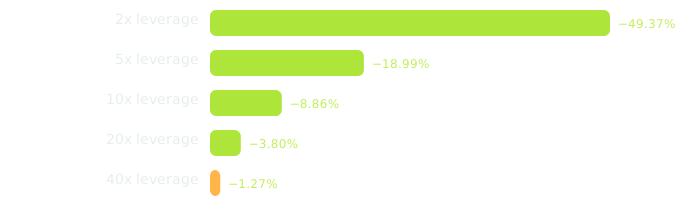
Regulators warn that crypto prices “can fall and rise quickly over short periods” [6]. At 20x or 40x leverage, a move of a few percent is enough to wipe out the margin.
What happens step by step during a liquidation?#
- Equity falls below maintenance margin
The venue measures this with a mark price, which on Hyperliquid combines external exchange prices with its own order book state [2].
- The position is sent to the order book
Market orders try to close it. If enough is closed to meet the margin requirement, any remaining collateral stays with the trader [2].
- Large positions close in slices
On Hyperliquid, for liquidatable positions larger than 100,000 USDC only 20% is first sent to the book as a market liquidation order; during the 30-second cooldown that follows, any further market liquidation orders for that user cover the entire position [2]. A hypothetical $250,000 position would first see $50,000 sent to the book.
- A backstop takes over if the book cannot
If equity drops below two-thirds of the maintenance margin, a liquidator vault takes the position, and the maintenance margin is not returned to the trader [2].
- Auto-deleveraging as the last resort
If an account goes negative, profitable traders on the other side can have positions closed against it so the platform carries no bad debt [7].
How are open interest and liquidations connected?#
Every liquidation closes a position, so liquidations reduce open interest. Data providers report them separately: DefiLlama tracks the collateral seized and, for perp exchanges, the liquidation volume — “the notional size of the liquidated positions, which is larger than the collateral lost because of leverage” [1]. Glassnode lists open interest and liquidations among its futures metrics, updated every 10 minutes [8].
A possible chain reaction follows from the mechanics. Forced closes are market orders [2], and large market orders can move the price when the book is thin — see order books and liquidity. A price move can then push other leveraged positions past their own liquidation prices. How often such cascades happen, and how large they are, cannot be read from open interest alone; treat this as a risk to respect, not a pattern to trade.
How can a trader reduce the risk of liquidation?#
- Use less leverage, or none. The bar chart above shows how quickly the room to move shrinks. Spot purchases cannot be liquidated.
- Know the liquidation price before you enter. Hyperliquid notes the estimate shown before a trade may be inaccurate because liquidity on the book changes [2].
- Exit earlier on your own terms. The same documentation suggests stop-loss orders or exiting before the mark price reaches the liquidation price, to avoid losing the maintenance margin in a backstop liquidation [2]. A stop-loss order is a stop order, which the CFTC describes as an order that “becomes a market order when a particular price level is reached” [3].
- Understand cross vs isolated margin. In cross mode, collateral is shared across positions; isolated margin confines losses to one position [9].
- Keep monitoring. Leverage is only checked when the position opens; afterwards, “the user is responsible for monitoring the leverage usage to avoid liquidation” [9].
Liquidation rules on one venue (Hyperliquid, as documented)
- Trigger
- Account equity below maintenance margin [2]
- Maintenance margin
- 1.25% to 16.7%, depending on the asset [2]
- Partial liquidation
- First 20% only for positions above 100,000 USDC [2]
- Backstop threshold
- Below 2/3 of maintenance margin [2]
- Final safeguard
- Auto-deleveraging of profitable opposite positions [7]
What mistakes do beginners make here?#
- Reading rising open interest as “money flowing in”
Dollar open interest rises with price even when no new positions open. Compare it with open interest in coins or contracts.
- Comparing open interest across sites
Some providers count one side, others both. Some include more venues than others. Check the methodology first.
- Trusting the liquidation price on the screen
It moves as funding is paid, fees are charged and, in cross margin, as your other positions change.
- Thinking a stop-loss always fills at your price
A stop turns into a market order when triggered, and in a fast market the fill can be worse than the stop price [11].
Frequently asked questions#
Is high open interest bullish or bearish?
Neither by itself. Every long has a matching short, so open interest shows how much leveraged positioning exists, not which side is right.
Why does open interest drop sharply during crashes?
Positions close — some voluntarily, some through liquidation. Each liquidation removes a position from the total.
Can I be liquidated on a spot purchase?
Not if you paid in full with your own money. Liquidation applies to positions that use borrowed funds or margin.
The bottom line#
Open interest tells you how much leveraged exposure is open; liquidations tell you how much of it was closed by force. Both are mechanical outcomes of margin rules, and those rules are set by each venue.
The single most useful number for a beginner is not market-wide open interest but your own liquidation price. If you cannot calculate it, do not open the position. Continue with perpetual futures and funding rates or the open interest metric.
Sources#
Grade A = primary source (regulator, protocol specification, client code, original author). Grade B = expert secondary source used for explanation only.
- BDefiLlama. Data Definitions (Open Interest, Liquidations), 2026.
- AHyperliquid Docs. Liquidations, 2026. Used as one example of how a venue documents liquidations; other venues differ.
- AU.S. Commodity Futures Trading Commission. Futures Glossary: A Guide to the Language of the Futures Industry, 2026.
- AHyperliquid Docs. Funding, 2026.
- AHyperliquid Docs. Entry price and pnl, 2026.
- AEuropean Supervisory Authorities (EBA, ESMA, EIOPA). EU financial regulators warn consumers on the risks of crypto-assets, 2022.
- AHyperliquid Docs. Auto-deleveraging, 2026.
- BGlassnode Docs. Datapoint Finalization, 2026.
- AHyperliquid Docs. Margining, 2026.
- AU.S. Commodity Futures Trading Commission. Customer Advisory: Understand the Risks of Virtual Currency Trading, 2026.
- AInvestor.gov, U.S. Securities and Exchange Commission. Stop Order (glossary), 2026.
Keep reading

Perpetual futures and funding rates: how a contract with no expiry stays near spot
A perpetual future never settles, so something else has to keep its price close to the real coin. That job falls to funding: small, regular payments between traders who are long and traders who are short.

Spot vs derivatives in crypto: owning a coin vs betting on its price
On a spot market you buy the coin itself. On a derivatives market you trade a contract whose value follows the coin’s price. That one difference changes what you own, what you can lose and which costs you pay.

Order books explained: how bids, asks and liquidity set the price you pay
An order book is the list of everyone currently willing to buy or sell, sorted by price. Reading it tells you the spread, how deep the market is, and roughly what a trade of your size will really cost.