Order books explained: how bids, asks and liquidity set the price you pay
An order book is the list of everyone currently willing to buy or sell, sorted by price. Reading it tells you the spread, how deep the market is, and roughly what a trade of your size will really cost.

Photo: “Tsukiji Fish Market” by Gunn Shots !, CC BY 2.0, via Flickr (edited: cropped and resized).
An order book lists open buy orders (bids) and sell orders (asks) by price. The gap between the highest bid and lowest ask is the spread [1]. A market order fills against resting orders, so a large order in a thin book can pay more than expected [2].
Key points
- 1Bids are offers to buy, asks are offers to sell; the gap between the top bid and top ask is the bid-ask spread.
- 2Market orders fill right away but can walk through several price levels, which is called slippage.
- 3Limit orders fix your worst acceptable price but may not fill.
- 4Liquidity is how much you can trade without moving the price much; depth near the mid price is the practical measure.
- 5Thin, opaque books are where beginners get the worst prices, so check depth before you trade size.
On this page
- What is an order book?
- What happens when you place a market order?
- How is a limit order different?
- What is liquidity, and how do you see it in the book?
- Why can thin order books be dangerous?
- How do order books compare with DEX liquidity pools?
- What mistakes do beginners make here?
- Frequently asked questions
- The bottom line
- Sources
What is an order book?#
An order book is a live list of buy and sell orders for one market, such as BTC/USD, organised by price. Uniswap’s documentation describes the central limit order book used by most public markets as one “where buyers and sellers create orders organized by price level that are progressively filled as demand shifts” [3]. Centralized crypto exchanges work this way: a Federal Reserve note observes that they “operate using traditional market makers and limit order books” [4].
Each side of the book has its own name. A bid is “an offer to buy a specific quantity of a commodity at a stated price”, and the ask is the price level of an offer to sell [1]. The highest bid and the lowest ask together form the top of the book. The bid-ask spread is simply the difference between them [1].
| Bid size | Bid price | Ask price | Ask size |
|---|---|---|---|
| 8 | $99.90 | $100.00 | 5 |
| 15 | $99.80 | $100.10 | 10 |
| 30 | $99.60 | $100.25 | 20 |
| 50 | $99.30 | $100.50 | 40 |
Sizes are in units of the asset. Top of book: highest bid $99.90, lowest ask $100.00. Spread $0.10. Mid price ($99.90 + $100.00) ÷ 2 = $99.95, so the spread is about 0.10% of the mid price.
What happens when you place a market order?#
A market order says “fill me now at whatever price is available”. Investor.gov explains the trade-off: as long as there are willing buyers and sellers you are almost always filled, but “the price you pay when your order is executed may not be the price you expected” [2]. The reason is visible in the book: a buy order takes the cheapest ask first, then the next, and so on until it is filled. Traders call this walking the book, and the extra cost compared with the top price is slippage.
| Step | Value |
|---|---|
| Fill 5 units at $100.00 | $500.00 |
| Fill 10 units at $100.10 | $1,001.00 |
| Fill the remaining 15 units at $100.25 | $1,503.75 |
| Total paid for 30 units | $3,004.75 |
| Average price = $3,004.75 ÷ 30 | $100.16 (0.16% above the lowest ask) |
| Compared with the mid price of $99.95 | 0.21% more |
| A 75-unit buy, same book: average price | $100.35 (0.35% above the lowest ask) |
| A 5-unit buy, same book: average price | $100.00 (no slippage) |
Selling works the same way in reverse: a 30-unit market sell would fill against the bids and average $99.78, 0.12% below the highest bid. The bigger the order relative to the book, the worse the average price.
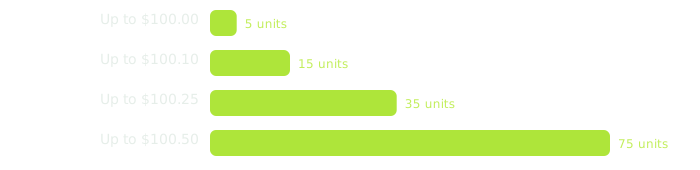
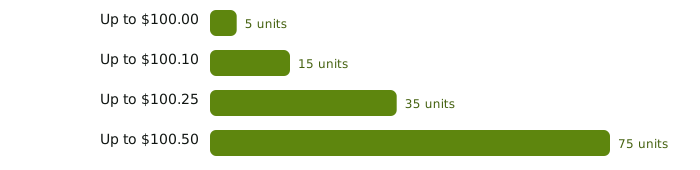
Cumulative units available on the ask side
How is a limit order different?#
A limit order sets the worst price you will accept. Hyperliquid’s documentation, as one example, defines it as an order that “executes at the selected limit price or better” [5]. If no one will trade at your price, the order rests in the book and becomes part of the liquidity other people trade against. The cost of that control is uncertainty: the order may fill partly, late, or never.
| Order | What it does | Main risk |
|---|---|---|
| Market | Fills immediately against resting orders | Average price can be worse than the quote |
| Limit | Fills only at your price or better | May not fill at all |
| Stop | Becomes a market order once a trigger price is reached | Can fill well below the stop in a fast market |
| Post only | Added to the book, never fills immediately | May wait in the book and never fill |
| Immediate or cancel | Whatever does not fill at once is cancelled | Partial fills |
Definitions follow Investor.gov for market and stop orders and Hyperliquid’s documentation for the others. Names and options vary by venue.
Stop orders deserve a special warning. Investor.gov notes that a stop becomes a market order when the stop price is reached, and that the execution price “may differ from the stop price, especially in a fast-moving market” [6]. A stop-loss limits time spent watching screens; it does not fix the exit price.
What is liquidity, and how do you see it in the book?#
Investor.gov describes the liquidity of a stock as how rapidly shares “can be bought or sold without substantially impacting the stock price” [7]. In an order book, that shows up in two places:
- The spread. A narrow spread means buyers and sellers agree closely on price. In our example it is about 0.10% of the mid price.
- Depth. How many units rest within a small distance of the mid price. In the example, 35 units are offered within 0.5% above the mid and 53 units are bid within 0.5% below it.
- Resilience. How quickly the book refills after a large trade. You can only see this by watching the book over time.
For judging liquidity, depth tells you more than reported trading volume. DefiLlama adjusts reported perpetual-futures volume by snapshotting order books and comparing volume “against the depth available around the mid price”, discounting volume that could not realistically have traded — such as wash trading or fabricated prints [8]. Some venues also cap the size of a single market order; Hyperliquid, for instance, sets maximum market order values per asset tier [9].
Why can thin order books be dangerous?#
European regulators list “market manipulation, lack of price transparency and low liquidity” among the key risks of crypto-assets, warning that you may not get a fair price or may not be able to sell as quickly as you want [10]. Investor.gov adds that assets with low liquidity “may be difficult to sell and may cause you to take a bigger loss” [7]. In a thin book, a single large order — including a forced liquidation — can move the price several levels, as the worked example shows. See open interest and liquidations for why that matters to leveraged traders.
How do order books compare with DEX liquidity pools?#
Many decentralized exchanges do not use an order book at all. Uniswap, for example, is an automated market maker: traders swap against a pool of two tokens priced by a formula, and “larger trades relative to pool depth move the price more” [3]. The idea of slippage is the same; the mechanism is different. Uniswap’s own documentation argues that order books need intermediary infrastructure and active market makers, which makes them a poor fit for many blockchain settings [11]. See centralized vs decentralized exchanges for the full comparison.
- Check the spread
Divide the gap between top bid and top ask by the mid price. A wide spread is a cost you pay on every round trip.
- Add up the depth for your size
Count how many units rest on the side you will hit before the price you are willing to pay.
- Estimate your average price
Walk the book as in the worked example. If slippage is large, use a limit order or trade smaller.
- Re-check before you click
Books change by the second. A quote from a minute ago is not a promise.
What mistakes do beginners make here?#
- Trusting the last traded price
The last trade is history. What you will pay depends on the asks resting now and on the size of your order.
- Using market orders in thin markets
A market order in a shallow book can fill far from the quote. Check depth first or use a limit order.
- Judging liquidity by volume alone
Reported volume can be inflated. Depth near the mid price is harder to fake and is what your order actually meets.
- Treating a stop-loss as a fixed exit price
It is not one: a triggered stop becomes a market order and fills at whatever the book offers at that moment.
Frequently asked questions#
Who puts orders in the order book?
Anyone placing limit orders, including professional market makers who quote both sides. A Federal Reserve note describes centralized exchanges as using traditional market makers and limit order books [4].
What does “depth” mean on an exchange chart?
It is the total size of resting orders at each price, usually drawn as a cumulative curve on each side of the mid price.
Why is the spread wider on small coins?
Usually because fewer participants are quoting, so the top bid and top ask sit further apart and each level holds less size. That is what low liquidity looks like in the book.
Is slippage the same as a fee?
No. A fee is charged by the venue. Slippage is the difference between the quoted price and your average fill, caused by your order eating through the book.
The bottom line#
The order book is where the price you see turns into the price you pay. The spread is the cost of crossing from one side to the other; depth decides how much a larger order will move against you.
Before any trade, look at the book for your size, not just the headline price. Then compare how decentralized exchanges handle the same problem with liquidity pools.
Sources#
Grade A = primary source (regulator, protocol specification, client code, original author). Grade B = expert secondary source used for explanation only.
- AU.S. Commodity Futures Trading Commission. CFTC Glossary: Bid, Ask, Bid-Ask Spread, 2026.
- AInvestor.gov, U.S. Securities and Exchange Commission. Market Order (glossary), 2026.
- AUniswap Developers. How Uniswap Works, 2026.
- ABoard of Governors of the Federal Reserve System (FEDS Notes). Primary and Secondary Markets for Stablecoins, 2024.
- AHyperliquid Docs. Order types, 2026. Used as one example of how a venue documents order types; other venues differ.
- AInvestor.gov, U.S. Securities and Exchange Commission. Stop Order (glossary), 2026.
- AInvestor.gov, U.S. Securities and Exchange Commission. Liquidity (or Marketability) (glossary), 2026.
- BDefiLlama. Data Definitions (Normalized Volume), 2026.
- AHyperliquid Docs. Contract specifications, 2026.
- AEuropean Supervisory Authorities (EBA, ESMA, EIOPA). EU financial regulators warn consumers on the risks of crypto-assets, 2022.
- AUniswap Developers. Pools, 2026.
Keep reading
CEX vs DEX: how centralized and decentralized crypto exchanges differ
A centralized exchange is a company that holds your funds and matches orders for you. A decentralized exchange is a set of smart contracts you trade against from your own wallet. Each removes some risks and adds others.

How decentralized exchanges work: pools, prices and the x × y = k rule
A decentralized exchange lets you swap tokens straight from your own wallet. Instead of matching buyers with sellers, most use a pool of tokens and a formula. Here is what that formula does to the price you get.

Open interest and liquidations: how leveraged positions build up and unwind
Open interest counts how many derivative positions are still open. Liquidations are what happens when a leveraged position runs out of margin and the venue closes it for you. Here is how both work, with the arithmetic.