Crypto volatility and risk: how big the swings are and what else can go wrong
Volatility is how far and how fast a price moves. In crypto it is large, but it is only one of several risks. Here is how volatility is measured, why it is so high, and how to prepare for it before you invest.

Photo: “Roller Coaster” by Nick Page Photos, CC BY 2.0, via Flickr (edited: cropped and resized).
Volatility measures how much a price swings. The CFTC defines it as a statistical measurement, “the annualized standard deviation of returns” [1]. Crypto prices can fall and rise quickly, and you can lose all the money you invest [2]. Platform failure, scams and leverage matter too.
Key points
- 1Volatility is a measure of how widely a price moves around, in both directions — not a measure of direction.
- 2Regulators describe crypto-assets as highly risky and speculative, with prices that can move sharply over short periods.
- 3Price volatility is one risk among several: liquidity, platform failure, scams, hacks and the lack of deposit-style protection all add to it.
- 4Leverage multiplies volatility: a modest price move can wipe out the money you put in.
- 5The practical defence is sizing: only put at risk money you can afford to lose entirely.
On this page
What does volatility mean in crypto?#
Volatility is how much and how quickly a price moves. The CFTC’s glossary defines it more precisely as “a statistical measurement (the annualized standard deviation of returns) of the rate of price change” of an asset [1]. A volatile asset can be up 10% one day and down 15% the next; a stable one barely moves. Volatility says nothing about direction: an asset that only ever rises fast is volatile too. What matters for you is that large swings make the value of your holding hard to predict over any short period.
Crypto is known for this. The FTC warns that a cryptocurrency’s value can change rapidly, even by the hour, and that cryptocurrencies tend to be more volatile than traditional investments such as stocks and bonds [3]. The CFTC makes a similar point about fiat money: virtual currencies are not backed by any government or central bank, and they are more volatile than traditional currencies [4].
How is volatility measured?#
Looking back at past prices gives historical volatility, which the CFTC describes as the annualized standard deviation of an instrument’s returns “over a specified number of past trading days” [1]. (Implied volatility is a different number, worked out from option prices with an options pricing model [1].) Data providers publish their own versions. Coin Metrics, for example, defines its 30-, 60- and 180-day volatility metrics as the standard deviation of the daily natural log returns over that window [6]. That describes a daily figure, while the CFTC definition is annualized, so check which one a chart shows before comparing numbers. A log return is ln(today’s price ÷ yesterday’s price), which for small moves is close to the ordinary percentage change. The standard deviation measures how spread out those daily returns are around their average.
Volatility (X days) = standard deviation of ln(Pₜ ÷ Pₜ₋₁) over the last X daysPₜ is the closing price on day t. Bigger daily jumps up or down give a bigger standard deviation, and therefore a higher volatility reading.
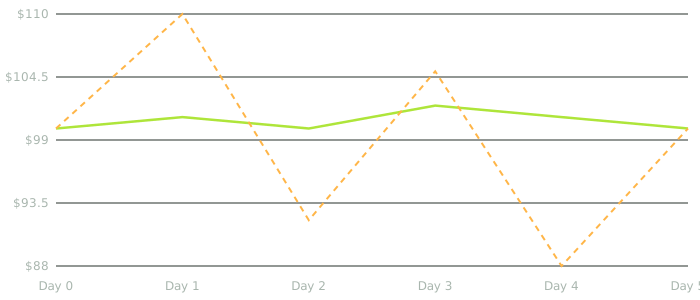
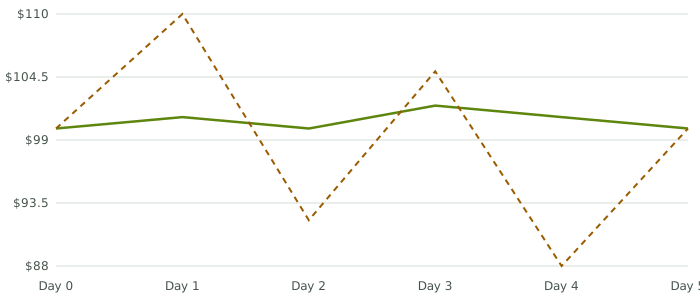
To see what the number captures, compare two hypothetical assets that both start and end a week at $100. One drifts gently; the other lurches up and down.
Same start, same end, very different ride
| Measure | Calm asset | Volatile asset |
|---|---|---|
| Daily moves | +1.0%, −1.0%, +2.0%, −1.0%, −1.0% | +10.0%, −16.4%, +14.1%, −16.2%, +13.6% |
| Std. deviation of daily log returns | 1.25% | 14.56% |
| Largest fall from a peak | −1.96% | −20.0% |
| Change over the whole period | 0% | 0% |
Population standard deviation of five daily log returns, not annualized. Real volatility metrics use 30 to 180 days of data.
Both assets “returned” nothing, but anyone who needed to sell the volatile one on day 4 would have taken a 20% loss from its peak. That is the practical meaning of volatility: it raises the odds that the price is far from where you want it on the day you need the money. Our guide to drawdowns and recovery math shows why falls of that size are harder to undo than they look.
Why are crypto prices so volatile?#
Regulators point to several features of the market. The European Supervisory Authorities (ESAs) say many crypto-assets are subject to sudden and extreme price movements because their price often relies solely on consumer demand, with no backing assets or other tangible value [2]. The CFTC says a virtual currency’s value is derived entirely from supply and demand [4].
- Concentrated holdings. The holding of certain crypto-assets is highly concentrated, which may affect prices and liquidity [2].
- Thin markets. You may not be able to sell as quickly as you want if there is no buyer [2].
- Manipulation. Cases of market manipulation have been reported on multiple occasions, and price formation on exchanges is often not transparent [2].
- Flash crashes. The CFTC lists volatile price swings and flash crashes among the risks of buying crypto in the cash market [4].
Is volatility the same as risk?#
No. Volatility is the risk you can see on a price chart. Several other risks can cost you money even when the price is calm — and they are the ones beginners tend to forget.
| Risk | What can happen | Source |
|---|---|---|
| Price volatility | Prices fall and rise quickly; you may lose all the money you invest | [2] |
| Liquidity | No buyer at a fair price when you want to sell | [2] |
| Platform failure | The company holding your crypto fails, halts withdrawals or goes bankrupt | [7] |
| Fraud and scams | Fake coins, Ponzi schemes, promoters who vanish with the money | [7] |
| Hacks and lost keys | Exchanges and wallets are attacked; lost private keys mean lost assets | [2] |
| No safety net | Crypto accounts are not insured by a government the way bank deposits are | [3] |
Fraud is not a side issue. In its 2024 annual report the FBI’s Internet Crime Complaint Center recorded 149,686 complaints involving cryptocurrency, with reported losses of about $9.3 billion [8]. See common crypto scams for the patterns to recognise.
Layers of risk around a crypto holding


What does leverage do to volatility?#
Leverage is, in the CFTC’s words, “the ability to control large dollar amounts of a commodity or security with a comparatively small amount of capital” [1]. On futures markets that typically means funding only a fraction of the position through a margin account [4]. The CFTC warns that leverage amplifies the underlying risk: when prices move against a leveraged position, traders must add money or close out, and in the end may lose more than their initial investment [4]. The SEC describes the same trade-off for margin accounts: more purchasing power, but exposure to larger losses [9].
| Step | Value |
|---|---|
| No leverage: loss on a 10% fall = $1,000 × 10% | $100 (10% of your money) |
| 5× leverage: exposure = $1,000 × 5 | $5,000 |
| 5× leverage: loss on a 10% fall = $5,000 × 10% | $500 (50% of your money) |
| 5× leverage: loss on a 20% fall = $5,000 × 20% | $1,000 (100% of your money) |
| No leverage: −10% then +10% on $1,000 | $990 |
A 20% fall is unremarkable in crypto, as the volatile path above shows. At 5× leverage it erases the whole stake. The last row is a reminder that even without leverage, an equal fall and rise leave you behind.
How can a beginner prepare for volatility?#
You cannot make an asset less volatile, but you can decide how much of it you hold. The SEC’s investor alert is blunt: the only money you should put at risk in any speculative investment is money you can afford to lose entirely [7]. How much that is depends on your risk tolerance — your ability and willingness to lose some or all of an investment in exchange for greater potential returns [10] — and on your time horizon, how long until you need the money [5].
- Ask the regulators’ questions first
Can you afford to lose all of it? Do you understand the product? Is the firm you use reputable? Can you protect your devices and keys? These come straight from the ESAs’ checklist [2].
- Size the position before you buy
Decide the most you accept losing, then work backwards. The position size calculator does the arithmetic.
- Skip leverage while learning
Leverage turns ordinary swings into total losses. There is no need for it to learn how markets behave.
- Write down your plan
The SEC advises creating and following an investment plan so short-term emotions do not disrupt long-term goals [7].
- Expect deep falls
Assume your holding could halve, or go to zero, and check you could live with that.
What mistakes do beginners make here?#
- Confusing volatility with opportunity
Big swings feel exciting on the way up. They are just as big on the way down, and you do not choose which comes first.
- Looking only at the price
Many crypto losses come from platforms failing, scams and lost keys, not from the chart. A calm price does not mean a safe holding.
- Using leverage to “make volatility work”
Leverage multiplies losses as well as gains, and can lose more than you put in.
- Investing money you need soon
A short time horizon leaves no room to wait out a fall. Money for rent or emergencies does not belong in a volatile asset.
- Assuming a recovery is certain
The FTC notes that if a crypto’s value goes down, there is no guarantee it will go up again [3].
Frequently asked questions#
Is bitcoin less volatile than other cryptocurrencies?
Volatility changes over time and differs between assets, so compare current 30- or 180-day readings from a data provider rather than relying on a general rule. All crypto-assets carry the risks regulators list.
Does high volatility mean higher returns?
Not necessarily. Volatility measures how widely returns vary, not whether they are positive. A volatile asset can lose most of its value and stay there.
Can I avoid volatility by holding stablecoins?
Stablecoins aim to hold a steady price, but they carry their own risks, including the issuer and the platform holding them. See what are stablecoins.
Are my crypto holdings insured like a bank account?
Generally no. The FTC notes that crypto held in accounts is not insured by a government like dollars in an FDIC-insured bank account [3].
How much of my savings should be in crypto?
We cannot answer that for you. The SEC’s minimum test is that it should be money you can afford to lose entirely, and it advises paying off credit cards or other high-interest debt first [7].
The bottom line#
Volatility is the visible part of crypto risk: prices can fall and rise quickly over short periods, and regulators warn you can lose everything you put in. The less visible parts — platforms, scams, keys and leverage — can cost you just as much.
Start with the arithmetic of how much you can afford to lose, then read diversification and position sizing to turn that number into a plan.
Sources#
Grade A = primary source (regulator, protocol specification, client code, original author). Grade B = expert secondary source used for explanation only.
- AU.S. Commodity Futures Trading Commission. Futures Glossary: A Guide to the Language of the Futures Industry, 2026.
- AEuropean Supervisory Authorities (EBA, ESMA, EIOPA). EU financial regulators warn consumers on the risks of crypto-assets, 2022.
- AU.S. Federal Trade Commission, Consumer Advice. What To Know About Cryptocurrency and Scams, 2022.
- AU.S. Commodity Futures Trading Commission. Customer Advisory: Understand the Risks of Virtual Currency Trading, 2026.
- AU.S. SEC, Investor.gov. Beginners’ Guide to Asset Allocation, Diversification, and Rebalancing, 2026.
- BCoin Metrics Data Knowledge Base. Volatility (VtyDayRet30d, 60d, 180d), 2026.
- AU.S. SEC, Investor.gov. Exercise Caution with Crypto Asset Securities: Investor Alert, 2023.
- AFederal Bureau of Investigation, Internet Crime Complaint Center. 2024 IC3 Annual Report, 2024.
- AU.S. SEC, Investor.gov. Margin Account, 2026.
- AU.S. SEC, Investor.gov. Risk Tolerance, 2026.
Keep reading

Drawdown recovery math: why a 50% loss needs a 100% gain
A drawdown is the fall from a peak to a low. The arithmetic of getting back is lopsided, and it gets worse the deeper the fall. Here is the math, with tables and worked examples.

Position sizing in crypto: deciding how much to put at risk
Position sizing answers one question before every purchase: how much can this lose without hurting me? Diversification and rebalancing keep the answer true over time. Here is the arithmetic, with worked examples.

Common crypto scams: how they work and how to spot them
Most crypto scams are old tricks with a new payment method. Here are the main types, the official loss figures, and the red flags that give them away.