Common crypto scams: how they work and how to spot them
Most crypto scams are old tricks with a new payment method. Here are the main types, the official loss figures, and the red flags that give them away.

Photo: “Fishing on Kalunkijärvi, Käylä near Ruka” by RukaKuusamo.com, CC BY 2.0, via Flickr (edited: cropped and resized).
The most common crypto scams are fake investment platforms, romance-to-investment schemes, impersonators of companies or government agencies, fake giveaways and phishing for your recovery phrase [1] [2]. In 2024 the FBI’s IC3 recorded about $9.3 billion in reported losses on complaints involving cryptocurrency [3].
Key points
- 1Scammers rarely break crypto’s cryptography. They persuade people to send funds or reveal their recovery phrase.
- 2Investment fraud is the costliest category in the FBI’s 2024 figures, at about $6.57 billion in reported losses across all payment types.
- 3Any demand for payment in crypto, or any promise of guaranteed returns, is a red flag according to the US Federal Trade Commission.
- 4Crypto payments usually cannot be reversed, so prevention matters far more than recovery.
- 5If you are targeted, stop paying, keep records and report it. Ignore anyone who offers to recover your money for a fee.
On this page
- How big is the crypto scam problem?
- Which crypto scams cost the most?
- What are the main types of crypto scams?
- How does a crypto investment scam unfold?
- Why do giveaways and celebrity endorsements fool people?
- How do phishing and fake support steal wallets?
- What is address poisoning?
- What red flags apply to almost every scam?
- What is a recovery scam?
- What should you do if you have been scammed?
- What mistakes do beginners make here?
- Frequently asked questions
- The bottom line
- Sources
How big is the crypto scam problem?#
The FBI’s Internet Crime Complaint Center (IC3) received 859,532 complaints in 2024, with reported losses of $16.6 billion — a record [3]. Complaints tagged as involving cryptocurrency numbered 149,686, with losses of $9,322,335,911 [3]. By our arithmetic, that is about 56% of all reported losses, from about 17% of complaints.
Reported losses by crime type, IC3 2024 (US$ billions)
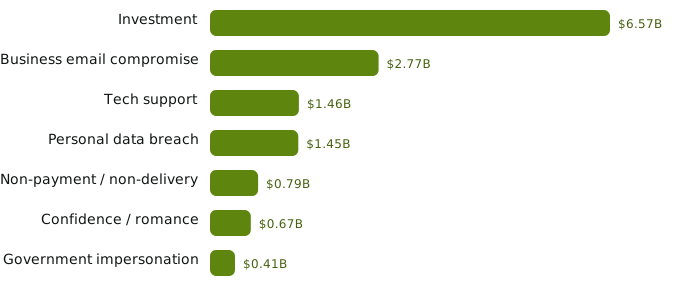
Two cautions. These are complaints people chose to file with a US agency, so they are not a full count of global fraud. And the crime types overlap with crypto rather than sitting beside it: IC3 uses “cryptocurrency” as a descriptor of the payment tool, added after a crime type is chosen [3].
Which crypto scams cost the most?#
The 2024 IC3 report has a separate section on cryptocurrency fraud. It counts 149,686 complaints with $9.3 billion in losses, which IC3 summarises as a 66% increase in losses, and the largest age group reporting was people aged 60 and over [4].
Investment scams dominate. Crypto investment fraud produced 41,557 complaints and $5.8 billion in losses in 2024, with complaints up 29% and losses up 47% from 2023 [4]. By our arithmetic, that is about 62% of all crypto-related losses, and about 89% of the $6.57 billion lost to investment fraud through every payment method [4] [3].
Crypto-related losses by crime type, IC3 2024 (US$ billions)
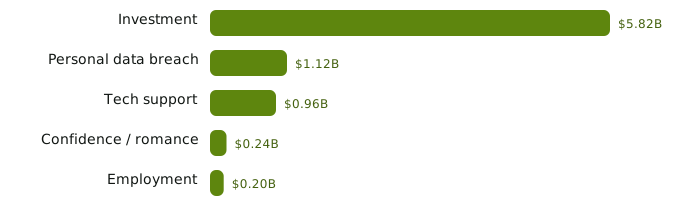
Older people lose the most. People over 60 filed 33,369 crypto-related complaints, with losses of $2,839,333,197 [4]. Not every complaint includes an age, so the age groups do not add up to the total [4].
What are the main types of crypto scams?#
| Scam | How it usually starts | The giveaway |
|---|---|---|
| Fake investment platform | An “investment manager” contacts you out of the blue [1] | You can’t withdraw, or only after paying high fees |
| Romance or friendship investment (“pig butchering”) | A “wrong number” text or a like from a stranger [5] | They never meet you, but always talk about trading |
| Giveaway or “send 1, get 2 back” | A livestream or post using a celebrity’s name [2] | Free money; a short time limit |
| Fake support agent | A private message after you ask for help in a public chat [2] | They ask for your recovery phrase or remote access |
| Company or government impersonator | A call, text or pop-up saying your account is at risk [1] | They tell you to buy crypto to “protect” your money |
| Phishing | An email, text or ad with a link to a copy of a real site [2] | The site asks for your seed phrase or password |
| Fake job | A job offer related to crypto [1] | You must pay a fee in crypto to start |
| Airdrop claim | Unknown tokens appear in your wallet [2] | The claim site asks you to approve a transaction |
| Address poisoning | A zero-value or fake-token transfer to a look-alike address appears in your history [6] | An address you never used, copied from your history |
| Recovery scam | After a loss, someone offers to get your money back [7] | They want a fee upfront |
How does a crypto investment scam unfold?#
Investment scams are where crypto plays a double role: it is both the “investment” and the payment method [1]. A common pattern is the romance or friendship scam, which criminal groups call sha zhu pan, or pig butchering. The US Commodity Futures Trading Commission says financial romance and grooming gangs stole more than $3.5 billion in 2023, and that the grooming phase can take several weeks [5].
The typical arc of a romance-investment scam


The FTC describes the same ending: the investment site looks real but is fake, and when you try to take money out you cannot, or only after paying high fees [1]. The early “profits” are numbers on a screen, there to make you send more.
| Step | Value |
|---|---|
| Starting deposit (hypothetical) | $1,000 |
| Claimed growth | 2% per day |
| After 30 days = 1,000 × 1.02³⁰ | ≈ $1,811 |
| After 365 days = 1,000 × 1.02³⁶⁵ | ≈ $1,377,408 |
| Implied yearly multiple | ≈ 1,377× |
No real market investment does that. The numbers only work on a fake dashboard, or by paying earlier investors with new deposits — the definition of a Ponzi scheme, which the SEC’s investor office warns is common in crypto promotions [8].
Why do giveaways and celebrity endorsements fool people?#
The giveaway scam asks you to send crypto to an address and promises to send back double — which is why it is also called the 2-for-1 scam. It usually comes with a short deadline to create urgency [2]. Scammers often re-stream an old interview with a well-known person so that it looks like a live endorsement [2]. In one case in July 2020, hacked social-media accounts of well-known people and organisations posted a bitcoin giveaway, and the hackers collected 11 bitcoin before the posts were deleted [2].
Even real endorsements prove little. The SEC’s investor office notes that celebrities are often paid to promote an investment and that an endorsement does not mean the investment is legitimate [8]. EU supervisors warn that social-media influencers typically have a financial incentive to market the products they talk about [9].
How do phishing and fake support steal wallets?#
Phishing is when criminals use scam emails, texts or calls to trick you, often into visiting a website that installs malware or collects your details [10]. It was the single most reported crime type to IC3 in 2024, with 193,407 complaints [3]. In crypto, the target is usually your recovery phrase: imitation websites ask you to enter it, reset a password or send funds [2]. Scammers can even spoof the link preview on social media so a malicious link appears to point to a real site [2].
Fake support works by building trust. Scammers watch public chat channels for people asking for help, then send a private message offering it — and eventually ask for keys or for funds [2]. Real staff will not contact you through private, unofficial channels [2]. IC3’s 2024 report also lists an FBI warning about scammers impersonating cryptocurrency exchanges [3].
What is address poisoning?#
Address poisoning is a scam that plants transfers to look-alike addresses in your wallet history, so that you later copy the wrong address and send tokens to the scammer [6]. Revoke.cash, a wallet-security service, describes two main versions [6].
- Fake tokens. The scammer creates a token with the same name as a popular one, such as USDC or USDT, and makes it look as if you sent tokens to the scammer’s address [6].
- Zero-value transfers. The scammer uses the real token’s
transferFromfunction to record a transfer of zero tokens from your address to a look-alike address [6]. No approval from you is needed: the function only checks that the amount is not more than the approved amount, and zero always passes that check [6].
The defence is simple. Never use your wallet history or a block explorer as the place you copy addresses from [6]. For an exchange deposit, copy the address from the exchange’s website every time; for a friend, ask them for it directly [6]. Then compare far more than the start and end of the address:
It is commonly recommended to verify the first and last 4 characters of the address, but this is actually not enough.
Revoke.cash, What Is Address Poisoning? [6]
The reason, Revoke.cash explains, is that scammers can create addresses with the same first and last four characters as the one you meant to use [6].
What red flags apply to almost every scam?#
- You are told to pay in crypto. The FTC says no legitimate business will demand that you send crypto in advance — not to buy something, and not to protect your money [1].
- Profits are promised. Nobody can promise guaranteed returns; the FTC treats any such promise as a sign of a scam [1].
- Someone you met online starts giving investment advice. Never mix online dating or friendship with investing [1].
- You are rushed. Short deadlines are designed to stop you from thinking or checking [2].
- The conversation moves to a private app. It is one of the CFTC’s warning signs [5].
- You must pay to withdraw. Fake “fees” or “taxes” to unlock your money are the final stage of the scam [5].
- Free money appears. Free crypto, doubled deposits and surprise airdrops that need you to “claim” them are not gifts [2].
What is a recovery scam?#
A recovery scam targets people who have already lost money. Someone says they can get your money back, but you must pay them first, and if you do, you lose more [7]. The US Federal Trade Commission explains that scammers buy, sell and trade lists of people who have already been scammed, expecting them to be good targets again [7]. The caller may claim to be from a government agency, a consumer group or a law firm [7], and ask for a “retainer fee”, “processing fee” or “tax” before any money is returned [7].
The FBI gives crypto scam victims the same warning: be wary of anyone claiming they can recover your funds, as this may be another scam [11]. Its list of 2024 public alerts includes one titled “Fictitious Law Firms Targeting Cryptocurrency Scam Victims Offering to Recover Funds”, dated 24 June 2024 [4].
What should you do if you have been scammed?#
- Stop sending money
Do not pay any “fee”, “tax” or “verification” charge to get funds back. Paying to withdraw is part of the scam [5].
- Secure what is left
If you shared a recovery phrase, treat that wallet as compromised: whoever holds the phrase can access every account in it [2]. Move any remaining funds to a new wallet with a new phrase.
- Keep records
Save messages, website addresses, wallet addresses and transaction IDs before the scammer deletes anything. The FBI says the most important details are the crypto addresses, the amount and type of crypto, the date and time, and the transaction ID (hash) [11].
- Report it
In the US, the FBI asks crypto scam victims to report to IC3 at ic3.gov without waiting, and to file a report even if they have no transaction details [11]. The FTC also lists ReportFraud.ftc.gov, the CFTC, the SEC and the exchange you used [1]. In the UK, the NCSC accepts reports of scam emails, texts, websites and adverts [10].
- Beware of “recovery” offers
The SEC’s investor office warns that recovering money from crypto fraudsters can be nearly impossible [8]. Anyone who asks for an upfront fee to get your money back is running a scam of their own, according to the FTC [7].
IC3 2024 at a glance
- All complaints
- 859,532 [3]
- All reported losses
- $16.6 billion [3]
- Complaints involving cryptocurrency
- 149,686 [3]
- Losses on complaints involving cryptocurrency
- $9,322,335,911 [3]
- Investment fraud losses (all payment types)
- $6,570,639,864 [3]
- Crypto investment fraud complaints
- 41,557 [4]
- Crypto investment fraud losses
- $5.8 billion [4]
What mistakes do beginners make here?#
- Trusting a website because it looks professional
Fake trading platforms copy the look of real ones and show convincing dashboards. Check how long a site has existed and whether the firm is registered with the regulator.
- Believing that small early withdrawals prove it is real
Letting you withdraw a little at first is a deliberate tactic to win a bigger deposit.
- Answering “support” messages you did not request
Real help desks do not reach out first in private messages. Contact support only through the official website you typed yourself.
- Paying a fee to unlock your own money
A platform that demands taxes or fees before releasing funds is almost always the scam itself, asking for one more payment.
- Copying an address from your transaction history
Address poisoning plants look-alike addresses there. Copy each address from its original source, every time.
Frequently asked questions#
Can I get my crypto back after a scam?
Usually not. Crypto payments generally can only be refunded by the person who received them [1]. Report the scam anyway: it can help investigators and protect others.
Can a company or lawyer recover my stolen crypto for a fee?
Is every crypto giveaway a scam?
Ethereum.org’s guidance is blunt: giveaways are always scams, and funds sent to them are lost [2]. If a giveaway asks you to send crypto first, do not.
How do I check whether a platform is legitimate?
What is “pig butchering”?
It is a long romance or friendship scam that ends in a fake crypto investment. The CFTC says the gangs behind these frauds call it “sha zhu pan”, or pig butchering, and that building the relationship can take several weeks before the fraud [5].
Are crypto ATMs used in scams?
The bottom line#
Crypto scams succeed through persuasion, not hacking. Almost all of them need you to do one of two things: send crypto to someone, or reveal a recovery phrase. If you never do either at a stranger’s request, most of these schemes simply fail.
Some newer tricks work through signatures and approvals rather than direct payments — see token approvals and wallet drainers. For how platforms themselves can fail, read custodial vs self-custody and crypto volatility and risk.
Sources#
Grade A = primary source (regulator, protocol specification, client code, original author). Grade B = expert secondary source used for explanation only.
- AU.S. Federal Trade Commission. What To Know About Cryptocurrency and Scams, 2022.
- Aethereum.org. Ethereum security and scam prevention, 2026.
- AFBI Internet Crime Complaint Center. 2024 IC3 Annual Report.
- AFBI Internet Crime Complaint Center. 2024 IC3 Annual Report — Cryptocurrency Fraud section. PDF pages 31–46: crypto complaints, losses by crime type and age, list of 2024 public alerts
- AU.S. Commodity Futures Trading Commission. Customer Advisory: Six Warning Signs of Online Financial Romance Frauds.
- BRevoke.cash. What Is Address Poisoning?.
- AU.S. Federal Trade Commission. Refund and Recovery Scams, 2023.
- AU.S. SEC Office of Investor Education and Advocacy (Investor.gov). Exercise Caution with Crypto Asset Securities: Investor Alert, 2023.
- AEuropean Supervisory Authorities (EBA, ESMA, EIOPA). EU financial regulators warn consumers on the risks of crypto-assets, 2022.
- AUK National Cyber Security Centre. Phishing scams: how to spot and report them, 2022.
- AFBI Internet Crime Complaint Center. FBI Guidance for Cryptocurrency Scam Victims (I-082423-PSA), 2023.
Keep reading
Token approvals and wallet drainers: how one signature can empty a wallet
To use most crypto apps you first give a smart contract permission to move your tokens. Scammers have learned to ask for that same permission. Here is how it works and how to stay in control.
What is a seed phrase? How 12 or 24 words protect a whole wallet
A seed phrase is the master backup of a self-custody wallet. Here is how the words are made, why they are so hard to guess, and why they are so easy to lose to a scammer.
Custodial vs non-custodial wallets: who really holds your crypto?
With a custodial account a company holds the keys and you trust it. With self-custody you hold the keys and carry the responsibility. Here is what changes, risk by risk.