What is bitcoin hashprice, and why did it fall after the October 2026 difficulty rise?
On 16 October 2026 Bitcoin's difficulty rose 5.92%. That one number cut what every unit of mining power can expect to earn. Here is the arithmetic behind hashprice.
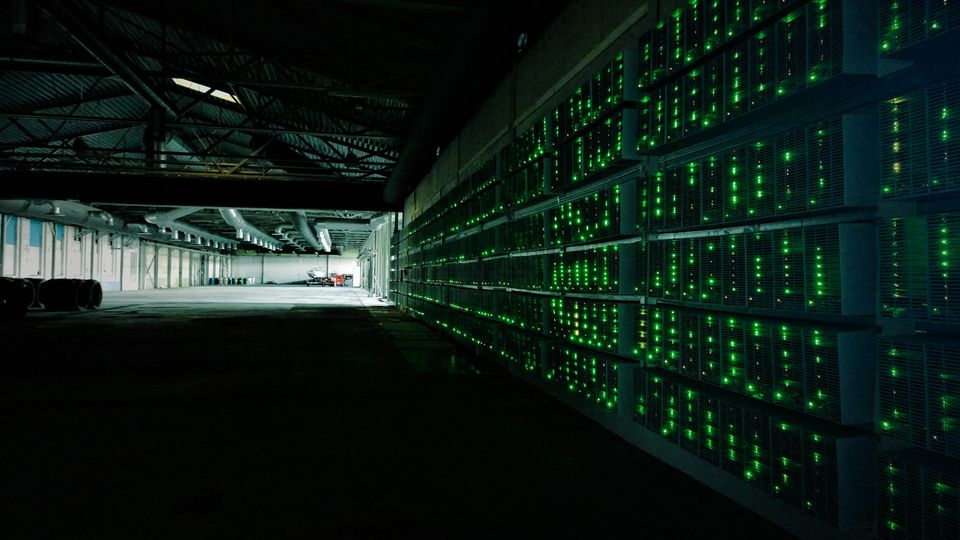
Photo: “Bitcoin mining farm” by Marko Ahtisaari, CC BY 2.0, via Wikimedia (edited: resized).
Hashprice is the expected mining revenue per unit of hash rate per day, for example satoshis per petahash per second. It rises with the block reward and falls when difficulty rises. After the 5.92% difficulty increase on 16 October 2026, subsidy-only hashprice in bitcoin terms fell about 5.6%.
Key points
- 1Hashprice = expected bitcoin earned per day by one unit of hash rate; it can be quoted in BTC (or sats) or converted to dollars.
- 2Bitcoin targets one block every 10 minutes and retargets difficulty every 2,016 blocks, so about 144 blocks are expected per day.
- 3The block reward is the subsidy (now 3.125 BTC) plus the fees in the block; in the 144 blocks we checked, fees were about 0.5% of the reward.
- 4Difficulty implies network hash rate (about difficulty × 2^32 ÷ 600 hashes per second), so a higher difficulty spreads the same reward over more hashing.
- 5On 16 October 2026 difficulty rose from 132.72 trillion to 140.58 trillion, cutting subsidy-only hashprice from about 47,368 to 44,719 sats per PH/s per day.
On this page
- What is hashprice, in plain words?
- How does difficulty change what miners earn?
- What did the October 2026 retarget do to hashprice?
- Why do fees and the halving matter for hashprice?
- How can you use hashprice without over-reading it?
- What mistakes do beginners make here?
- Frequently asked questions
- The bottom line
- Sources
What is hashprice, in plain words?#
Mining is a lottery in which each hash is a ticket. Hashprice turns that lottery into an average: the bitcoin a given amount of hashing power can expect to earn per day. It is usually expressed per petahash per second (PH/s, a quadrillion hashes each second) so that machines and whole farms can be compared on the same scale. Because it is an expectation, any single miner's actual results bounce around it.
Three inputs set it. The block reward is the block subsidy (newly available satoshis) plus the transaction fees paid by the transactions in the block [1]. The block rate is fixed by design. And difficulty decides how many hashes, on average, it takes to win a block. For the supply side of the reward, see bitcoin supply and halving.
Hashprice (BTC per PH/s per day) = 144 × (subsidy + average fees per block) × 10^15 ÷ (difficulty × 2^32 ÷ 600)144 blocks a day follows from the 600-second target spacing in Bitcoin Core [2]; the network hash rate implied by a difficulty D is D × 2^32 ÷ 600 hashes per second, as the Bitcoin Wiki derives [3].
How does difficulty change what miners earn?#
Bitcoin Core sets a target spacing of 10 × 60 seconds per block and a target timespan of two weeks [2]. The Bitcoin Wiki explains that difficulty is adjusted every 2016 blocks based on the time it took to find the previous 2016 blocks; if they came faster than two weeks, difficulty goes up [3]. The full mechanism is in difficulty adjustment explained.
Because retargeting keeps blocks arriving at about 144 a day on average, whatever the total hashing power, the network's daily reward is roughly fixed in bitcoin terms. When more machines join, they share the same pie, and the next retarget raises difficulty so that each hash wins less often. That is why hashprice in BTC moves in the opposite direction to difficulty: a 5.92% rise in difficulty means each unit of hash rate is expected to earn 1 ÷ 1.0592 of what it did, about 5.6% less.
The 16 October 2026 retarget
What did the October 2026 retarget do to hashprice?#
Using mempool.space's record of every adjustment, difficulty moved from 132.72 trillion to 140.58 trillion at block 971,712 on 16 October 2026 [4]. Plugging both values into the formula, with the current subsidy, gives the change in what each unit of hash rate can expect.
| Step | Value |
|---|---|
| Implied network hash rate before | ≈ 950 EH/s |
| Implied network hash rate after | ≈ 1,006 EH/s |
| Subsidy-only hashprice before | 47,368 sats per PH/s per day |
| Subsidy-only hashprice after | 44,719 sats per PH/s per day (−5.59%) |
| After, including average fees | 44,941 sats per PH/s per day |
| A 200 TH/s machine, per day, after | ≈ 8,988 sats |
Fees added only about 0.5% to the reward in the blocks we checked, so the subsidy and difficulty did almost all the work.
Subsidy-only hashprice, sats per PH/s per day


Why do fees and the halving matter for hashprice?#
The subsidy started at 50 bitcoins and is halved every 210,000 blocks [6], and Bitcoin Core encodes the same 210,000-block interval [2]. Each halving cuts the subsidy part of hashprice in half overnight, so unless difficulty falls or fees rise, hashprice in BTC halves too. Fees are the part that can grow: when blocks are full and users bid more, the reward per block rises — see transaction fees explained.
| Change | Effect on hashprice in BTC | Why |
|---|---|---|
| Difficulty rises | Falls | Same reward shared across more hashing |
| Difficulty falls | Rises | Fewer hashes needed per block |
| Halving | Subsidy part halves | Subsidy halves every 210,000 blocks |
| Fees rise | Rises | Block reward = subsidy + fees |
| Bitcoin price rises | No change in BTC; rises in USD | Price only affects the dollar conversion |
How can you use hashprice without over-reading it?#
Hashprice is an average for the whole network at one moment. It ignores electricity, machine efficiency, pool fees and luck. A small solo miner faces enormous variance: with 200 TH/s at today's difficulty, the expected time to find a block alone is about 96 years by the Bitcoin Wiki's formula [3] — a reminder that one machine's results can differ wildly from the network average. For the revenue side as a whole, the Puell multiple and hash rate pages show related views.
- Check the unit
BTC or USD, per TH/s or per PH/s, per day — figures are not comparable otherwise.
- Note the difficulty and date
Hashprice resets at every retarget, roughly every two weeks.
- Separate subsidy from fees
Fee-driven spikes can fade; the subsidy part is fixed until the next halving.
- Add your own costs
Revenue per hash means little without power cost and machine efficiency.
What mistakes do beginners make here?#
- Treating hashprice as profit
It is revenue. Electricity, hardware and pool fees come out of it.
- Mixing up BTC and USD hashprice
A higher bitcoin price lifts dollar hashprice but leaves the BTC figure unchanged.
- Expecting steady income from a small machine
Hashprice is an average. Solo mining with a single machine can mean decades between blocks.
- Forgetting the next retarget
Difficulty changes every 2,016 blocks, so today's hashprice is a snapshot.
Frequently asked questions#
Why did hashprice fall when difficulty rose?
The daily reward is roughly fixed at about 144 blocks [2]; higher difficulty means each hash wins less often, so expected BTC per unit of hash falls by about 1 − 1/1.0592 ≈ 5.6% for a 5.92% rise.
What is the bitcoin block subsidy now?
3.125 BTC: it started at 50 bitcoins and halves every 210,000 blocks [6], and four halvings have happened by block 971,712.
How big are fees compared with the subsidy?
In the 144 blocks from 971,739 to 971,882, fees averaged about 0.0155 BTC per block, roughly 0.5% of the total reward [5].
Is hashprice the same as the hash rate?
No. Hash rate is how much hashing the network does; hashprice is what one unit of that hashing is expected to earn. Difficulty links the two [3].
When is the next difficulty adjustment?
Every 2,016 blocks [3]; after block 971,712 the next retarget falls at block 973,728.
The bottom line#
Hashprice condenses mining economics into one number: the expected bitcoin a unit of hash rate earns per day. It rises with the subsidy and fees and falls as difficulty climbs, which is exactly what happened when difficulty rose 5.92% on 16 October 2026.
Use it as a snapshot that resets every two weeks and halves with each halving, and remember it measures revenue, not profit.
Sources#
Grade A = primary source (regulator, protocol specification, client code, original author). Grade B = expert secondary source used for explanation only.
- ABitcoin Developer Documentation. Glossary (Developer Documentation), 2026.
- ABitcoin Core (GitHub). Bitcoin Core chainparams.cpp (consensus parameters), 2026.
- BBitcoin Wiki. Difficulty, 2026.
- Bmempool.space. Difficulty adjustments (API, all), 2026.
- Bmempool.space. Mining reward stats, last 144 blocks (API), 2026.
- ABitcoin Developer Documentation. Block Chain (Developer Reference), 2026.
Keep reading
Bitcoin difficulty adjustment: how the network keeps blocks near ten minutes
Miners join and leave all the time, yet Bitcoin blocks keep arriving roughly every ten minutes. The reason is a simple feedback rule that every node runs every 2,016 blocks.

Bitcoin halving explained: how the 21 million supply schedule works
Every 210,000 blocks the number of new bitcoins created per block is cut in half. Here is the rule, the arithmetic behind the cap, and the claims about halvings you should treat with care.
Crypto transaction fees explained: what you pay and why
Every on-chain transaction pays for space in a block. Bitcoin charges by size, Ethereum by computation. Here is how each fee is calculated, with worked examples, and what makes fees jump.