Bitcoin halving explained: how the 21 million supply schedule works
Every 210,000 blocks the number of new bitcoins created per block is cut in half. Here is the rule, the arithmetic behind the cap, and the claims about halvings you should treat with care.

Photo: “Pile O'Change” by frankieleon, CC BY 2.0, via Flickr (edited: cropped and resized).
A Bitcoin halving is the point, every 210,000 blocks, where the new-coin reward paid to miners per block is cut in half [1]. It started at 50 BTC per block and repeats until the reward rounds down to zero, which caps total issuance just under 21 million BTC [2].
Key points
- 1The halving is a consensus rule written into Bitcoin’s software, triggered by block height, not by a calendar date.
- 2The per-block subsidy started at 50 BTC and halves every 210,000 blocks; after four halvings it is 3.125 BTC.
- 3Because the subsidy shrinks geometrically, total issuance approaches, but never reaches, 21 million BTC.
- 4Halvings change how many new coins enter circulation. They do not, by themselves, set the price.
On this page
- What exactly gets cut in half?
- Where is the halving rule written?
- How does the schedule add up to 21 million?
- When were the past halvings?
- How much new bitcoin is created per day now?
- Does a halving make the price go up?
- What does a halving change for miners?
- What mistakes do beginners make here?
- Frequently asked questions
- The bottom line
- Sources
What exactly gets cut in half?#
Each new block on the Bitcoin blockchain begins with a special transaction, the coinbase transaction, that creates new coins and pays them to whoever produced the block. The whitepaper describes this as the incentive that rewards nodes for supporting the network [3]. That reward has two parts: the block subsidy (newly created bitcoin) and the transaction fees paid by everyone whose transaction is included [4].
The halving applies only to the subsidy. Fees are set by users competing for block space, so they are not halved — and as the subsidy shrinks, fees become a larger share of what miners earn. The whitepaper anticipated this: once a predetermined number of coins has entered circulation, the incentive can transition entirely to transaction fees [3].

Where is the halving rule written?#
In Bitcoin Core, the reference software most nodes run, the main-network parameters set nSubsidyHalvingInterval = 210000 [1]. The same codebase defines one bitcoin as 100,000,000 of the smallest unit (a satoshi) and sets a sanity limit MAX_MONEY of 21 million coins [5]. Every full node checks new blocks against these rules, so a miner who tries to pay itself more than the allowed subsidy produces a block that other nodes reject.
That is the practical meaning of “fixed supply”: no company can decide to issue more, because the rule is enforced independently by every node that validates blocks. Changing it would require the people running nodes to adopt different software — a change the network has never made.
How a block’s reward is checked


How does the schedule add up to 21 million?#
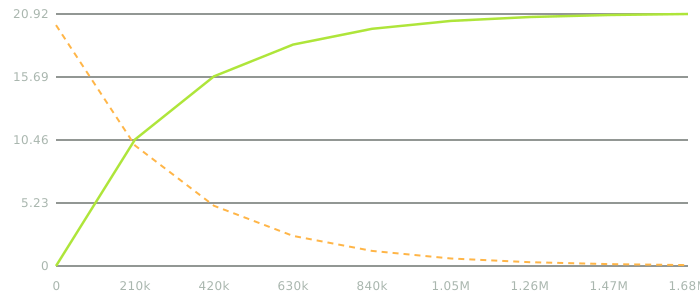
Each era lasts 210,000 blocks. Multiply the subsidy in each era by 210,000 and you get the coins issued in that era: 10.5 million in the first, 5.25 million in the second, 2.625 million in the third, and so on. Each era issues half as much as the one before, so the running total climbs toward 21 million without reaching it [2].
| Era (block heights) | Subsidy per block | New BTC in era | Scheduled total at end of era |
|---|---|---|---|
| 0 – 209,999 | 50 BTC | 10,500,000 | 10,500,000 (50.00%) |
| 210,000 – 419,999 | 25 BTC | 5,250,000 | 15,750,000 (75.00%) |
| 420,000 – 629,999 | 12.5 BTC | 2,625,000 | 18,375,000 (87.50%) |
| 630,000 – 839,999 | 6.25 BTC | 1,312,500 | 19,687,500 (93.75%) |
| 840,000 – 1,049,999 | 3.125 BTC | 656,250 | 20,343,750 (96.88%) |
Percentages are of the final scheduled total of 20,999,999.9769 BTC. Figures are the maximum the rules allow; coins that were never claimed or are lost reduce the real circulating supply.
Why “just under” 21 million? Amounts are stored as whole numbers of satoshis, and halving is done by dropping fractions of a satoshi. Summing every era with that rounding gives a final total of 20,999,999.9769 BTC [2]. Under the assumption that blocks keep arriving at roughly their target pace, the subsidy reaches zero around the year 2140 [2].
Scheduled supply by halving era
When were the past halvings?#
- Block 210,000 · 2012-11-28Subsidy fell from 50 to 25 BTC [2].
- Block 420,000 · 2016-07-09Subsidy fell from 25 to 12.5 BTC [2].
- Block 630,000 · 2020-05-11Subsidy fell from 12.5 to 6.25 BTC [2].
- Block 840,000 · 2024-04-20Subsidy fell from 6.25 to 3.125 BTC [2].
- Block 1,050,000 · not yet reachedSubsidy will fall to 1.5625 BTC. The date depends on how fast blocks are found until then.
How much new bitcoin is created per day now?#
The difficulty adjustment targets one block every ten minutes on average — six per hour, or 144 per day [6]. At the current subsidy, that is a planned issuance of about 450 new BTC per day, before fees. The real number moves around because blocks are sometimes found faster or slower than the target — see the difficulty adjustment.
| Step | Value |
|---|---|
| Blocks per hour (target) | 6 |
| Blocks per day = 6 × 24 | 144 |
| Subsidy per block (era 4) | 3.125 BTC |
| New BTC per day = 144 × 3.125 | 450 BTC |
| Same figure in era 3 = 144 × 6.25 | 900 BTC |
This is scheduled issuance only. Fees are paid from coins that already exist, so they move bitcoin around rather than create it.
Does a halving make the price go up?#
Nothing in the protocol links a halving to price. What changes is the flow of new coins that miners receive and may sell. Whether that matters depends on demand, on how much of the existing supply holders decide to sell, and on everything else happening in markets. Past halvings are few — four so far — which is far too small a sample to treat any pattern as reliable.
What does a halving change for miners?#
Overnight, the subsidy part of every block reward drops by half while miners’ electricity and hardware costs stay the same. Miners with the highest costs may switch machines off, which lowers the network’s hash rate until the difficulty adjustment rebalances how hard blocks are to find [6]. Analysts track this squeeze with metrics such as the Puell Multiple, which compares daily issuance value with its yearly average.
The rules in one place
What mistakes do beginners make here?#
- Treating the halving date as fixed
Halvings are triggered by block height. Any date you see is an estimate that shifts as block times vary.
- Thinking fees are halved too
Only the newly created subsidy is halved. Fees depend on demand for block space.
- Assuming 21 million coins will circulate
The scheduled total is slightly below 21 million, and coins lost through forgotten keys never come back, so the usable supply is lower still.
- Reading four past cycles as a law
Four events cannot establish a reliable price pattern. Treat halving-cycle charts as history, not as a forecast.
Frequently asked questions#
When is the next Bitcoin halving?
At block height 1,050,000. The date is an estimate that depends on how quickly blocks are mined until then; block explorers show a running estimate based on recent block times.
Can the 21 million cap be changed?
Only if the people who run nodes adopt software with different rules. The cap is enforced by every validating node, not by a company, and it has never been changed.
What happens when all bitcoin has been issued?
Miners would be paid only by transaction fees. The whitepaper describes this transition explicitly [3].
Do other cryptocurrencies have halvings?
Some coins copied Bitcoin’s design and have their own schedules; others, such as Ether, have no fixed cap. Check each network’s own documentation rather than assuming.
Is the halving the same as a stock split?
No. A stock split changes the number of shares each holder owns. A halving changes nothing about existing balances; it only reduces how many new coins are created per block.
The bottom line#
The halving is one of the few things in crypto that is fully predictable: a rule, enforced by every node, that halves new issuance every 210,000 blocks until it reaches zero. What it does to the price is not predictable, and anyone who claims otherwise is forecasting.
If you want to see how analysts measure the effect on miners and holders, continue with the hash rate and realized price profiles.
Sources#
Grade A = primary source (regulator, protocol specification, client code, original author). Grade B = expert secondary source used for explanation only.
- ABitcoin Core (GitHub). src/kernel/chainparams.cpp (nSubsidyHalvingInterval), 2026.
- BBitcoin Wiki. Controlled supply, 2026.
- ASatoshi Nakamoto. Bitcoin: A Peer-to-Peer Electronic Cash System, 2008.
- Abitcoin.org developer documentation. Bitcoin Developer Glossary: Block reward, 2026.
- ABitcoin Core (GitHub). src/consensus/amount.h (COIN, MAX_MONEY), 2026.
- BBitcoin Wiki. Difficulty, 2026.
- AEuropean Supervisory Authorities (EBA, ESMA, EIOPA). EU financial regulators warn consumers on the risks of crypto-assets, 2022.
Keep reading
How Bitcoin mining works: a step-by-step guide for beginners
Mining is how new Bitcoin blocks are made and how new coins enter circulation. Here is what a miner actually does, why it takes so much computing work, and how the rewards are paid.
Bitcoin difficulty adjustment: how the network keeps blocks near ten minutes
Miners join and leave all the time, yet Bitcoin blocks keep arriving roughly every ten minutes. The reason is a simple feedback rule that every node runs every 2,016 blocks.

Lightning Network explained: how Bitcoin payment channels work
Lightning lets two people pay each other many times while touching the Bitcoin blockchain only to open and close a channel. Here is how that works, why it is hard to cheat, and what it asks of you in return.