Dollar-cost averaging in crypto: what it does and what it doesn’t
Dollar-cost averaging means investing the same amount on a schedule, whatever the price. It takes the guesswork out of timing — but it is not a shield against losses. Here is the arithmetic, worked through.
Photo: “Calendar pages” by rmkoske, CC BY-SA 2.0, via Flickr (edited: cropped and resized).
Dollar-cost averaging (DCA) means investing equal amounts at regular intervals regardless of price, so you buy more units when prices are low and fewer when they are high [1]. It reduces the risk of bad timing. It does not prevent losses if the price falls and stays down.
Key points
- 1DCA is a schedule, not a prediction: the same amount on the same dates, whatever the price.
- 2Because a fixed amount buys more units at low prices, your average cost is never above the simple average of the prices you paid.
- 3In a steadily rising market a lump sum at the start ends higher; in a falling market DCA loses less but still loses.
- 4DCA does nothing about platform failure, scams or an asset going to zero.
- 5Fixed fees on small purchases can quietly eat a large share of each buy.
On this page
What is dollar-cost averaging?#
The SEC’s investor education site defines dollar-cost averaging as investing your money in equal portions, at regular intervals, regardless of the ups and downs in the market. It says the strategy can help you manage risk by following a consistent pattern of adding money over a long period, and that you will buy more of an investment when its price is low and less when it is high [1].
In crypto, that usually means a recurring purchase: say $100 of an asset on the first of every month. The opposite approach is a lump sum — investing the whole amount at once. Neither is “correct”. They answer different worries: DCA protects you from putting everything in just before a fall; a lump sum avoids missing a rise while you wait.
How does DCA change your average cost?#
Each purchase buys amount ÷ price units. When the price is low, the same $100 buys more units, so low prices carry more weight in your average. That is the whole mechanism.
Average cost per unit = Total invested ÷ Total units boughtWith equal amounts, this works out lower than the simple average of the prices whenever the prices differ, and equal to it when they are all the same.
| Purchase | Price | Units bought | Total units |
|---|---|---|---|
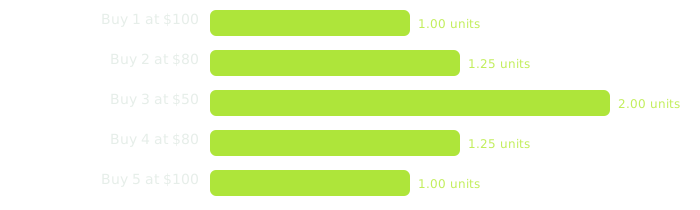
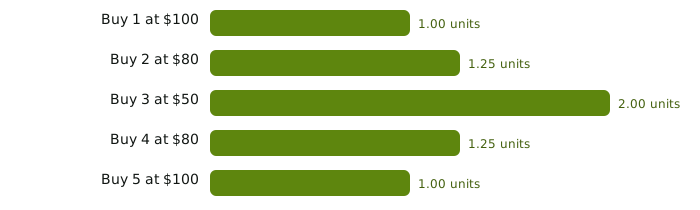
| 1 | $100 | 1.00 | 1.00 |
| 2 | $80 | 1.25 | 2.25 |
| 3 | $50 | 2.00 | 4.25 |
| 4 | $80 | 1.25 | 5.50 |
| 5 | $100 | 1.00 | 6.50 |
Hypothetical prices, the same as the default inputs of our DCA calculator.
Units bought by each $100 purchase
| Step | Value |
|---|---|
| Total invested = 5 × $100 | $500.00 |
| Total units = 1 + 1.25 + 2 + 1.25 + 1 | 6.50 |
| Average cost per unit = $500 ÷ 6.5 | $76.92 |
| Simple average of the prices = ($100 + $80 + $50 + $80 + $100) ÷ 5 | $82.00 |
| Value at the last price = 6.5 × $100 | $650.00 |
| Gain at the last price = $650 − $500 | +$150.00 (+30.00%) |
The price finished where it began, yet the plan shows a gain — but only because the price came back. Stop the story after purchase 3, with the price still at $50: $300 invested, 4.25 units worth $212.50, a loss of $87.50. Try your own numbers in the DCA calculator.
Does DCA beat investing a lump sum?#
It depends entirely on the path the price takes, which nobody knows in advance. The table compares DCA with investing the same total at the first price, over three hypothetical paths.
| Price path | DCA value at end | Lump-sum value at end | Which ended higher? |
|---|---|---|---|
| Rising: $50 → $80 → $100 | $425.00 | $600.00 | Lump sum |
| Falling: $100 → $80 → $50 | $212.50 | $150.00 | DCA (still a loss) |
| Down and back: $100 → $80 → $50 → $80 → $100 | $650.00 | $500.00 | DCA |
$300 invested in the first two rows, $500 in the third.
Read the falling row carefully: DCA “won”, but both approaches lost money. This is why DCA is best described the way the SEC describes it — as a way to manage risk through consistency [1] — and not as a way to increase returns. The CFTC’s blunt reminder applies here too: there is no such thing as a guaranteed investment or trading strategy [2].
What does DCA not protect you from?#
- An asset that never recovers. Regulators warn that you may lose all the money you invest in crypto-assets [3]. Buying more of something on the way to zero only adds to the loss.
- Platform failure. The SEC lists the potential for the company holding your crypto to fail or go bankrupt, and notes some platforms have suspended withdrawals [4]. Recurring buys usually sit on one platform, which concentrates that risk.
- Scams. A regular purchase into a fake coin is still a scam. The FTC warns that a promise of guaranteed profits or big returns is a sign of a scam [5].
- Volatility while you hold. DCA smooths your entry price, not the value of what you already own. See crypto volatility and risk.
How do fees affect small regular purchases?#
DCA often means many small buys, and some platforms charge a fixed fee per purchase. A fixed fee weighs far more on a small order than on a large one. Check your platform’s fee schedule before choosing the size and frequency of your purchases.
| Step | Value |
|---|---|
| Fee on a $25 purchase = $1 ÷ $25 | 4.0% |
| Fee on a $100 purchase = $1 ÷ $100 | 1.0% |
| Fee on a $500 purchase = $1 ÷ $500 | 0.2% |
| Twelve monthly $100 purchases: fees = 12 × $1 | $12 on $1,200 invested (1.0%) |
The $1 fee is invented for illustration. Real fees vary by platform and payment method, and percentage fees and price spreads add to the cost.
How do you set up a DCA plan?#
- Decide the total you can afford to lose
The SEC’s rule for any speculative investment: only money you can afford to lose entirely [4]. Pay off high-interest debt first.
- Pick an amount and a schedule
Weekly or monthly, at an amount where fees are a small share of each buy.
- Write the plan down
The SEC advises creating and following an investment plan so short-term emotions do not disrupt long-term goals [4].
- Record every purchase
Date, amount, price and units. You need them to know your real average cost — the profit calculator can help.
- Review, don’t react
Revisit the plan on a set date, not after a big price move. If crypto grows past its planned share, steer new money elsewhere to rebalance.
That last step uses a technique from the SEC’s guide to rebalancing: if you make continuous contributions, you can direct them to under-weighted parts of your portfolio until it is back in balance [6]. It lets a DCA plan keep crypto at the share you chose without selling.
What mistakes do beginners make here?#
- Treating DCA as a profit plan
It only spreads your purchase dates. If the price falls and stays down, a DCA plan loses money.
- Stopping the plan after a fall
Low prices are where DCA buys the most units. Abandoning the schedule in a slump turns it into buying high and quitting low.
- Increasing the amount after a rally
Raising purchases because prices went up is market timing, which is exactly what DCA was meant to remove.
- Ignoring per-purchase fees
A fixed fee on a tiny weekly buy can cost several percent each time.
- Averaging into anything
DCA does not turn a poor or fraudulent project into a good one. Evaluate the asset first.
Frequently asked questions#
How often should I buy with DCA?
Weekly and monthly are common. More frequent purchases smooth your entry price slightly more but can cost more in fees. Pick a rhythm you can keep up.
Is DCA better than investing all at once?
Not always. In a rising market a lump sum at the start ends higher; in a falling one DCA loses less. Nobody knows in advance which market you are in.
Can I use DCA to sell, too?
Yes. Selling equal amounts on a schedule spreads out your exit in the same way, and has the same limits.
Should I DCA into several coins?
That multiplies fees and does not necessarily diversify you if the coins tend to move together. See diversification and position sizing.
Does DCA work in a bear market?
It buys more units at low prices, which helps only if prices later recover. If they don’t, those extra units are worth less than you paid.
The bottom line#
Dollar-cost averaging is a useful discipline: it removes the pressure of picking the perfect day and keeps you buying when headlines are gloomy. It is not a profit engine and not a safety net — the outcome still depends on where the price goes and on the platform and asset you chose.
Run your own purchase history through the DCA calculator, and read crypto market cycles explained to see why the path of prices matters so much.
Sources#
Grade A = primary source (regulator, protocol specification, client code, original author). Grade B = expert secondary source used for explanation only.
- AU.S. SEC, Investor.gov. Dollar Cost Averaging, 2026.
- AU.S. Commodity Futures Trading Commission. Customer Advisory: Understand the Risks of Virtual Currency Trading, 2026.
- AEuropean Supervisory Authorities (EBA, ESMA, EIOPA). EU financial regulators warn consumers on the risks of crypto-assets, 2022.
- AU.S. SEC, Investor.gov. Exercise Caution with Crypto Asset Securities: Investor Alert, 2023.
- AU.S. Federal Trade Commission, Consumer Advice. What To Know About Cryptocurrency and Scams, 2022.
- AU.S. SEC, Investor.gov. Beginners’ Guide to Asset Allocation, Diversification, and Rebalancing, 2026.
Keep reading

Crypto market cycles explained: booms, busts and what we really know
Crypto prices have moved in long waves of rising and falling markets. Here is the vocabulary, the popular halving theory, the metrics analysts watch — and why none of it lets you time the market.

Crypto volatility and risk: how big the swings are and what else can go wrong
Volatility is how far and how fast a price moves. In crypto it is large, but it is only one of several risks. Here is how volatility is measured, why it is so high, and how to prepare for it before you invest.

Position sizing in crypto: deciding how much to put at risk
Position sizing answers one question before every purchase: how much can this lose without hurting me? Diversification and rebalancing keep the answer true over time. Here is the arithmetic, with worked examples.