News analysis ·
Dormant bitcoin moves: what on-chain data can't show
Long-idle bitcoin is moving as Google's Willow result revives quantum fears. What the transfers measure on-chain, and why they cannot reveal motive.
Google says its Willow quantum chip cut errors roughly 40-fold while preparing special quantum states, and CoinDesk tied the result to a growing worry about bitcoin's oldest coins. At the same time, coins idle for more than a decade have started to move on-chain. This article looks at what those movements actually measure, and why they cannot tell us whether holders are reacting to quantum fears.
What the chain recorded
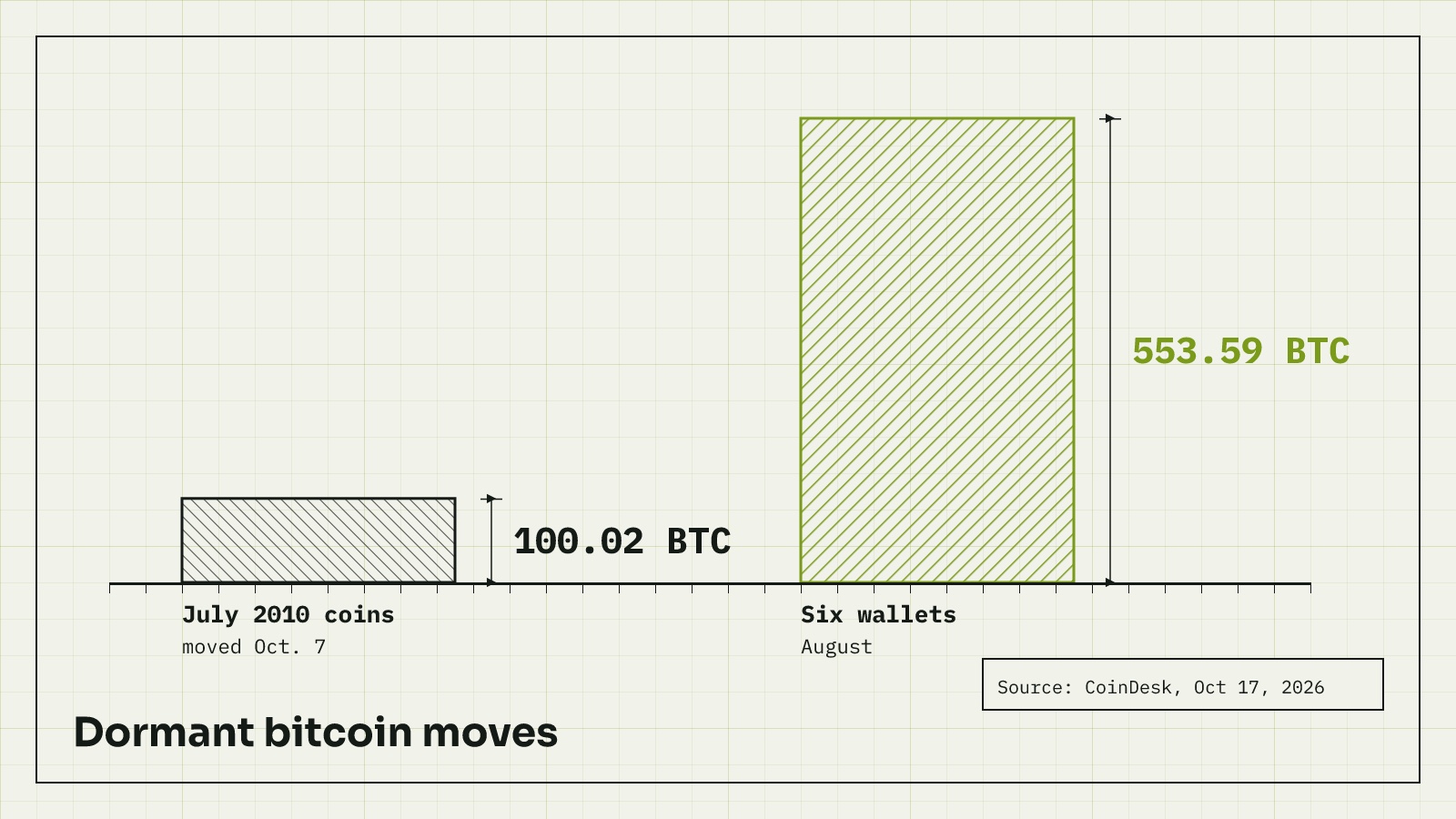
According to CoinDesk, a batch of 100.02 BTC last touched in July 2010 moved on Oct. 7, the first time in over 16 years. CoinDesk put its value near $8.5 million. Earlier, during August, a group of six wallets that had been quiet since 2011–2014 sent out 553.59 BTC, then valued by the outlet at roughly $40 million.
These are facts anyone can check. A bitcoin transaction is public, so the age of the coins being spent is visible to every node. What is not visible is the reason. CoinDesk itself cautioned that these transfers alone do not prove owners are reacting to quantum worries. A move can also mean switching wallets, reorganizing holdings or getting ready to sell.
Why old coins sit at the center of the quantum debate
A bitcoin wallet uses two linked keys. The secret key signs a payment. The public key lets the network check that signature. Working backwards from the public key to the secret key is meant to be impractical. In theory, Shor's algorithm, run on a quantum machine of sufficient size, could do it. That method dates from 1994 and has never been demonstrated in practice.
Spending usually reveals the public key. Some older payment types show it from the very start, and newer formats hide it behind a hash, a short digital fingerprint, until the owner spends. The CoinDesk report put the problem plainly: "Some of bitcoin’s oldest holdings have had their public keys exposed since they were mined." If the owners of those coins have lost their keys, they cannot move them into stronger protections. Because an attacker would work from data already on the blockchain, a recovery phrase kept offline does not help.
What is on-chain analysis measuring here?
On-chain analysis means reading the public ledger itself: which coins moved, how long they had been still, and what kind of output held them. For dormant coins, analysts usually track coin age. A metric such as Coin Days Destroyed weights each moved coin by how long it sat unspent, so a single transfer of very old coins shows up as a sharp spike.
The same ledger also lets analysts sort coins by script type. That is how researchers can say which holdings have a public key already visible and which are still hidden behind a hash. In other words, the chain can show where the exposure sits. It cannot show who controls the keys, or whether those keys still exist.
Limits: why the signal can mislead
Old coins moving makes a dramatic headline. Before reading it as a reaction to quantum news, keep these gaps in mind.
- Motive is invisible. A transfer looks the same whether the owner is upgrading security, consolidating wallets or preparing a sale, as CoinDesk noted.
- Timing is not cause. The moves came during a louder quantum debate, but a coincidence in time does not link the two.
- Ownership is a guess. A move from an old address may come from the original miner, an heir or someone who bought the keys long ago. The chain records keys, not people.
- Dollar values are snapshots. Figures like $8.5 million or $40 million reflect the price at the time, not anything about the holder's intent.
Coin-age metrics remain useful for spotting that something unusual happened. They are weak tools for explaining why.
Reading the Willow result carefully
The hardware news has its own fine print. The technique Google calls cultivation begins from a crude draft of a so-called magic state, the special input a quantum computer consumes to run certain operations. It checks each attempt for errors and discards the failures. Google cited about 99.99% fidelity, but only for states that passed the checks. Roughly 8% of attempts survived, about eight per 100 tries.
CoinDesk stressed that this is not another 40-fold cut in the cost of attacking bitcoin. Google's March estimate, which put a future machine at under 500,000 physical qubits under specific hardware assumptions, already assumed this approach. That paper also modeled an attack of about nine minutes once a public key is visible, needing roughly 500,000 reliable magic states each second.
What to watch next
On the research side, the next steps named by the researchers are running cultivation at far larger scale, handling real-time operation and feeding the states into sturdier error-correction schemes. On the chain, watch for further spikes in coin-age metrics and for coins leaving outputs whose public keys were exposed from the start. Each such move is a verifiable data point. Treat the story attached to it as a hypothesis until there is more evidence.
Sources
- CoinDesk, 17 Oct 2026
Drafted by AI from the research and on-chain sources listed, then published automatically once checks confirmed the figures against those sources and found no copied text. Not reviewed by a person. Metrics are explained, never turned into price calls.