Ethereum gas fees explained: what you pay and why
Every action on Ethereum costs gas. This guide breaks the fee into its parts, works through real arithmetic, and explains why a failed transaction can still cost you money.
Photo: “Chicago: U.S. Interstate 80 toll booth close-up” by jetzenpolis, CC BY 2.0, via Flickr (edited: cropped and resized).
A gas fee is what you pay Ethereum to run your transaction. It equals the gas units used multiplied by the base fee plus your priority fee (tip) [1]. The base fee is set by the protocol and burned; the tip goes to the validator who includes your transaction [2].
Key points
- 1Gas measures computational work. A plain ETH transfer uses 21,000 gas; contract interactions use more.
- 2Fee = gas used × (base fee + priority fee). Prices are quoted in gwei, one billionth of an ETH.
- 3The base fee rises or falls by up to 12.5% per block depending on how full the previous block was.
- 4You pay for the gas your transaction used even if it fails, so a too-tight gas limit can cost money.
- 5Fees are always paid in ETH on Ethereum, so keep some ETH in any wallet that holds tokens.
On this page
- What is gas, and why does Ethereum need it?
- What are wei and gwei?
- How is a gas fee calculated?
- What are the base fee, the priority fee and the max fee?
- What is the gas limit, and what happens if it is too low?
- Why do gas fees go up and down?
- Did The Merge or staking lower gas fees?
- How can you keep gas costs under control?
- What mistakes do beginners make here?
- Frequently asked questions
- The bottom line
- Sources
What is gas, and why does Ethereum need it?#
Gas is the unit that measures how much computational effort an operation takes on Ethereum [1]. Think of it like the fuel a car burns: a short trip uses a little, a long one uses a lot. Every node in the network has to repeat your computation, so that work has to be paid for.
The fee is not only about paying validators. It also protects the network. The Ethereum whitepaper explains that every transaction must set a limit on how many computational steps it may use, to prevent accidental or hostile infinite loops and other wasted computation [3]. Without a price per step, anyone could flood the network with junk for free [1].
What are wei and gwei?#
Gas fees must be paid in ether (ETH), but ETH is far too large a unit for prices per gas. So fees are quoted in gwei, short for giga-wei. One gwei is one billionth of an ETH [1]. The smallest unit is the wei, named after Wei Dai, creator of b-money [1].
| Unit | Value in wei | Value in ETH |
|---|---|---|
| wei | 1 | 10⁻¹⁸ ETH |
| gwei | 10⁹ wei | 0.000000001 ETH |
| ether (ETH) | 10¹⁸ wei | 1 ETH |
Denominations as defined in the ethereum.org glossary [4]. Saying “gas costs 1 gwei” is the same as saying 0.000000001 ETH per unit of gas.
How is a gas fee calculated?#
Since EIP-1559 went live in the London upgrade [5], your fee has two price parts and one quantity [1]:
Fee = Gas used × (Base fee + Priority fee)Gas used is how much work your transaction needed. The base fee is a per-gas price set by the protocol. The priority fee (tip) is a per-gas extra you offer the validator.
| Step | Value |
|---|---|
| Gas used by a plain ETH transfer | 21,000 |
| Price per gas = 10 + 2 | 12 gwei |
| Total fee = 21,000 × 12 | 252,000 gwei = 0.000252 ETH |
| Burned (base fee) = 21,000 × 10 | 210,000 gwei = 0.00021 ETH |
| Paid to validator (tip) = 21,000 × 2 | 42,000 gwei = 0.000042 ETH |
| Leaves Jordan’s account | 1.000252 ETH |
Taylor receives exactly 1 ETH. The fee comes on top of the amount sent. What that fee is worth in dollars depends on the ETH price at the time.
What are the base fee, the priority fee and the max fee?#
EIP-1559, the proposal behind this fee design, split the old single “gas price” into separate pieces with separate destinations [2]. Knowing who sets each piece explains most of what you see in a wallet’s fee screen.
| Setting | Who decides it | What happens to it |
|---|---|---|
| Base fee (per gas) | The protocol, from the previous block | Burned — destroyed, paid to no one [2] |
| Priority fee / tip (per gas) | You (your wallet suggests one) | Paid to the validator who includes the transaction [1] |
| Max fee (per gas) | You, as a ceiling | Anything above base fee + tip is never charged [1] |
A transaction that offers only the base fee is valid, but the tip is what rewards a validator for including it [1], so a no-tip transaction may wait longer. The tip is how you signal urgency: when many people want the same block, those who tip more tend to get in first.
| Step | Value |
|---|---|
| Max you authorised = 21,000 × 20 | 420,000 gwei (0.00042 ETH) |
| Actually charged = 21,000 × (10 + 2) | 252,000 gwei (0.000252 ETH) |
| Not charged = 21,000 × (20 − 12) | 168,000 gwei (0.000168 ETH) |
The max fee is a cap, not a price. You pay the block’s base fee plus your tip, and the difference up to the cap stays in your account [1].
What is the gas limit, and what happens if it is too low?#
The gas limit is the most gas you allow a transaction to use. A standard ETH transfer needs 21,000 units; interacting with smart contracts needs more, because the code does more work [1]. ethereum.org describes three cases [1]:
- Limit higher than needed — for example 50,000 for a plain transfer. The transfer uses 21,000 and the unused 29,000 is not charged.
- Limit below the minimum — for example 20,000 for a plain transfer. The transaction is rejected before it enters a block, and no gas is consumed.
- Runs out halfway through — a contract call uses up its whole limit mid-execution. The changes are reverted, but all the gas provided is still consumed for the work done.
Why do gas fees go up and down?#
Each block has a target size of half the block gas limit. If the previous block was fuller than the target, the base fee goes up; if it was emptier, it goes down. The change is proportional to the gap and capped at 12.5% per block — from −12.5% for an empty block to +12.5% for a completely full one [1]. In the EIP the cap comes from a constant: the change is divided by 8, and one-eighth is 12.5% [2].
Base fee after a run of completely full blocks
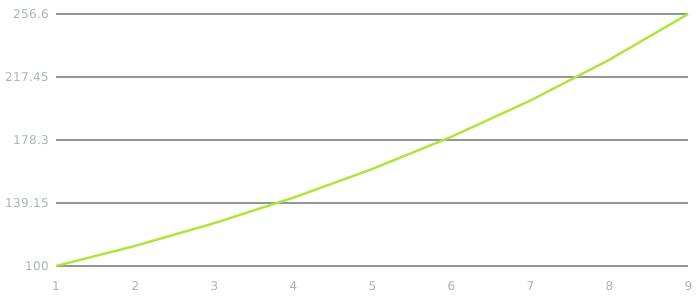
That compounding is deliberate. After a run of full blocks the base fee climbs so quickly that it becomes uneconomic to keep blocks full for long [1]. It also makes fees predictable: a wallet knows the next block’s base fee can be at most 12.5% higher than the current one. In ethereum.org’s example, after a block with a 202.7 gwei base fee, the next can be no higher than 228.1 gwei [1].
Fees are high, in short, when many people want block space at the same time, and when the apps they use run a lot of code [1]. For a comparison with Bitcoin’s fee market, see crypto transaction fees explained; for the full story of the burn, read EIP-1559 explained.
Did The Merge or staking lower gas fees?#
No. ethereum.org lists this as a common misconception: The Merge changed how blocks are agreed on, not how much the network can process, and it was never intended to lower fees [6]. The main effort to reduce costs is layer 2 scaling [1], where rollups execute transactions outside the main chain and post the data back to Ethereum, so many transactions share one Mainnet transaction [7]. See layer 2 rollups explained.
How can you keep gas costs under control?#
- Let the wallet estimate
Most wallets set a recommended base fee and tip automatically [1]. Change them only if you understand the trade-off.
- Check the current level
Gas price estimators such as Etherscan or Blockscout show what fees are currently being paid, so you can see whether the network is busy [1].
- Wait if it is not urgent
Because the base fee follows demand, a transfer that can wait may cost less later. Nothing guarantees it will.
- Consider a layer 2
For frequent small transactions, a rollup can be far cheaper, with extra risks of its own.
- Keep ETH for fees
Leave enough ETH in the wallet to pay for the next transaction, including any you may need to undo an approval.
What mistakes do beginners make here?#
- Confusing gas units with gas price
21,000 is an amount of work; 12 gwei is a price per unit of that work. The fee is the two multiplied together.
- Holding tokens but no ETH
Fees on Ethereum are paid in ETH. Wrapped ether (WETH) cannot pay for gas natively [8].
- Cutting the gas limit to save money
If a contract call runs out of gas halfway, the changes are undone and the gas is still spent.
- Setting a huge tip “just in case”
The tip is paid in full to the validator. A high max fee is a safe cap; a high tip is money spent.
- Expecting fees to stay the same
The base fee can change by up to 12.5% every block. A quote from a few minutes ago can be out of date.
Frequently asked questions#
Who gets the gas fee?
The base-fee part is burned and goes to no one; the tip goes to the validator who included your transaction [2].
Why did I pay a fee for a failed transaction?
Because the network still performed the computation. The fee is charged whether the transaction succeeds or fails [1].
How much gas does sending ETH use?
A standard ETH transfer uses 21,000 gas. Sending a token or using an app costs more because a smart contract has to run [1].
Why do I need ETH to send a stablecoin?
Stablecoins are tokens run by smart contracts on Ethereum, and every transaction on Ethereum pays its fee in ETH, whatever asset it moves.
Can I cancel a pending transaction?
Only one transaction with a given nonce (sequence number) can ever be executed from an account [9], so some wallets let you replace a pending transaction with a new one that reuses the nonce and pays a higher fee. Once a transaction is in a block, it cannot be undone.
The bottom line#
A gas fee is a quantity times a price: the gas your transaction uses, multiplied by the base fee plus your tip. The base fee follows demand block by block and is burned; the tip pays the validator; the max fee is only a ceiling.
Once you can read those three numbers, a wallet’s fee screen stops being a mystery. Next, see how the burn affects ETH supply in EIP-1559 explained, or get the one-line definition of gas.
Sources#
Grade A = primary source (regulator, protocol specification, client code, original author). Grade B = expert secondary source used for explanation only.
- Aethereum.org. Ethereum gas and fees: technical overview, 2026.
- AEthereum Improvement Proposals. EIP-1559: Fee market change for ETH 1.0 chain, 2019.
- Aethereum.org (Vitalik Buterin). Ethereum Whitepaper, 2014.
- Aethereum.org. Ethereum glossary, 2026.
- Aethereum.org. What is Ethereum?, 2026.
- Aethereum.org. The Merge, 2026.
- Aethereum.org. Scaling, 2026.
- Aethereum.org. What is Wrapped Ether (WETH), 2026.
- Aethereum.org. Ethereum accounts, 2026.
Keep reading

EIP-1559 explained: how Ethereum’s base fee and fee burn work
In August 2021 Ethereum stopped running a simple fee auction and started burning part of every fee. Here is the rule, the arithmetic behind it, and the claims about it that go further than the rule does.

Layer 2 rollups explained: how Ethereum scales without bigger blocks
Rollups run transactions off Ethereum’s main chain and post the results back to it. Here is how that works, where the savings come from, and which trust assumptions you take on when you use one.
Crypto transaction fees explained: what you pay and why
Every on-chain transaction pays for space in a block. Bitcoin charges by size, Ethereum by computation. Here is how each fee is calculated, with worked examples, and what makes fees jump.