News analysis ·
MEXC Sanctions Exposure: Reading FinCEN's Figures
FinCEN is cutting MEXC Global off from US institutions. We explain what its sanctions exposure figures measure on-chain and where they fall short.
On November 6, FinCEN, the US Treasury unit that fights financial crime, ordered US financial institutions to stop moving money to or from the exchange MEXC Global, Chainalysis reported. The order rests on a set of dollar figures describing how much of the exchange's activity touched sanctioned parties. This article looks at what those exposure numbers measure, how analysts build them from public blockchain data, and what they cannot tell you.
What FinCEN says it found
According to Chainalysis, FinCEN describes MEXC Global as a large venue. It launched in 2018, handled more than $1 billion in trades a day and held reserves near $5 billion. Its rules bar users in Iran and North Korea. FinCEN says compliance gaps let sanctioned parties in anyway.
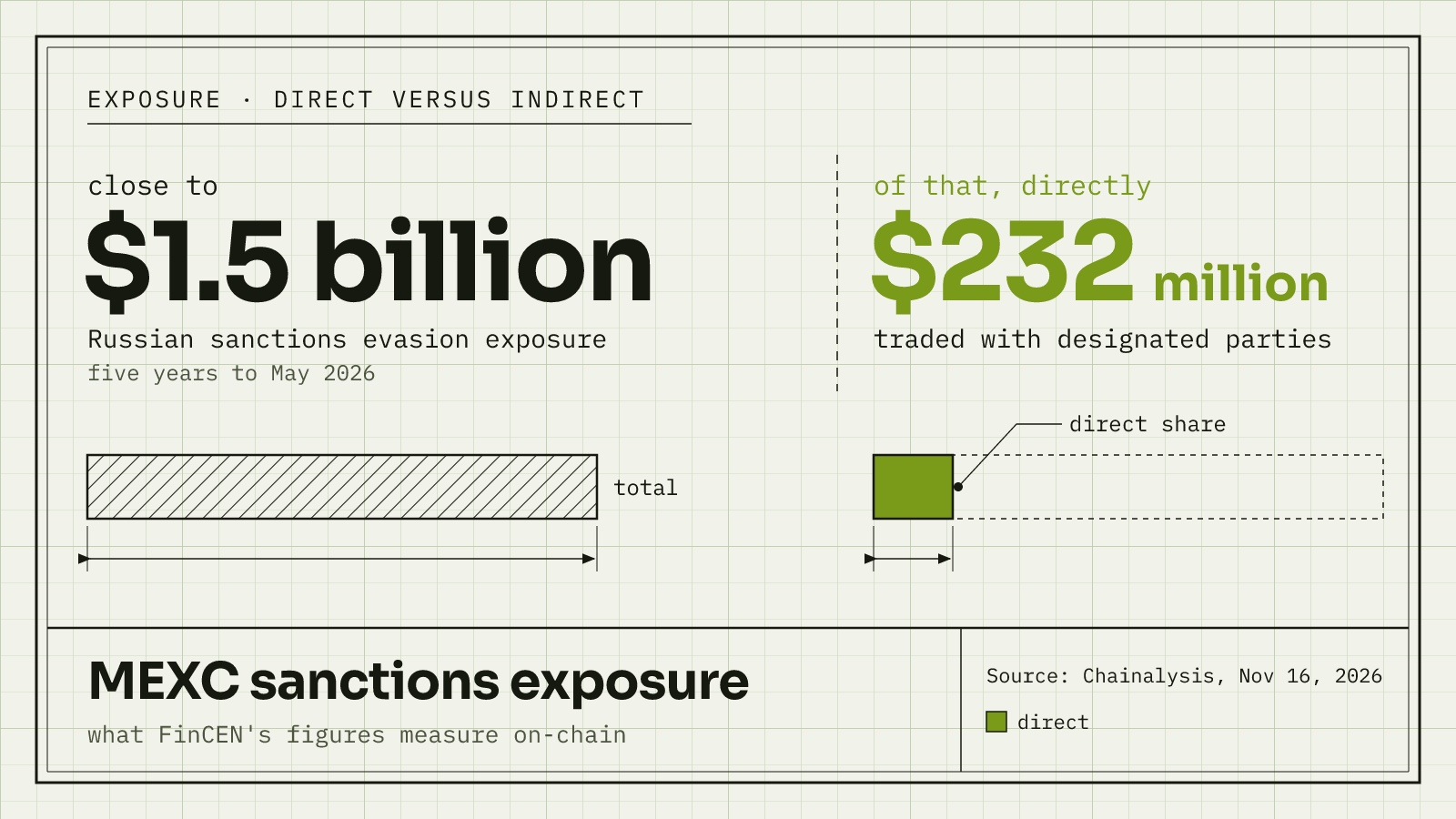
Russia sits at the centre of the case. Over the five years to May 2026, FinCEN counted close to $1.5 billion of exposure to Russian sanctions evasion. Of that, $232 million was traded directly with designated parties. FinCEN also says transactions with Garantex, and with Grinex, the venue that replaced it, continued as late as June 2026.
The list goes on. At least $26 million benefited the sanctioned A7 Network, and nearly $200 million was linked to that network's ruble-backed A7A5 token. About $1 billion moved directly between MEXC and more than 40 Iran-based exchanges. Roughly $22 million was tied to the IRGC-Qods Force and the Central Bank of Iran, and a further $36 million to Iranian proxy groups including the Al-Qassam Brigades. A sanctioned North Korean launderer, Sim Hyon Sop, received approximately $350,000 even though his designation was more than two years old.
The method: how sanctions exposure is measured on-chain
Exposure is a measure of how much value flowed between a service and a group of addresses labelled as risky. It is not a measure of intent. The work starts with labels. Investigators tie addresses to known entities, such as a sanctioned exchange like Garantex, using sanctions lists, seized records, court filings and patterns in how wallets behave.
Once the labels exist, the blockchain does the rest. Every transfer between addresses is public, so an analyst can add up the value that moved between an exchange's deposit and withdrawal wallets and the labelled addresses. That total, over a chosen time window, becomes the exposure figure.
The key split is direct versus indirect. Direct exposure means coins moved straight between the two sides with no stop in between. That is the kind FinCEN describes for the $232 million traded with designated parties and the roughly $1 billion that moved straight between MEXC and Iranian exchanges. Indirect exposure counts value that passed through one or more intermediate wallets first. The broader $1.5 billion Russian figure covers sanctions-evasion activity in general, not only direct trades with listed names.
So, is crypto traceable? On a public blockchain, yes: transfers between addresses can be followed hop by hop. What turns a trail into a finding is the label at the end of it, and that label comes from outside the chain.
Limits: why exposure numbers can mislead
Exposure figures are useful, but a reader should hold them loosely. Several blind spots apply.
- Labels can be wrong or late. An address only counts once someone has tagged it, so totals depend on whose label set is used and when.
- Direct and indirect are not equal. A hop-by-hop trace can sweep in value that passed near a sanctioned party without any link to the end user.
- Exchange wallets pool funds. Inside a big exchange, many customers share the same addresses, so on-chain data alone rarely shows which account a flow belonged to.
- A dollar total is not a share. The figures here are absolute amounts over a long window. They do not by themselves say what portion of all activity was tainted.
None of this means FinCEN's numbers are weak. It means the on-chain part is one layer of evidence, and a news summary shows only some of it.
What the order does, and what to watch
The order takes effect on December 10, 2026 and has no end date. From then, US banks and other institutions may no longer send money to the exchange or accept money from it. Their Bank Secrecy Act obligations stay the same, and that includes Suspicious Activity Reports. MEXC Global entities based in the United States fall outside the order. Chainalysis framed the step as part of a Treasury effort to starve Tehran of money, with crypto-based sanctions evasion one of the targets.
One detail shows a real limit of blockchains. FinCEN accepts that some firms may receive crypto from MEXC that they have no technical way to refuse, since anyone can send coins to a public address. It lets them decline or return such transfers depending on the case. Watch how exchanges and custodians handle these unwanted inbound transfers after December 10, and whether flows linked to the exchange start routing through extra hops, which would push more activity into the harder-to-read indirect category.
Sources
- Chainalysis, 13 Nov 2026
Drafted by AI from the research and on-chain sources listed, then published automatically once checks confirmed the figures against those sources and found no copied text. Not reviewed by a person. Metrics are explained, never turned into price calls.