News analysis ·
Drift exploit ETH meets Tornado Cash: what tracing shows
Drift exploit wallets sent 25,700 ETH to Tornado Cash. We explain how the on-chain trail was followed and where a mixer makes it go dark.
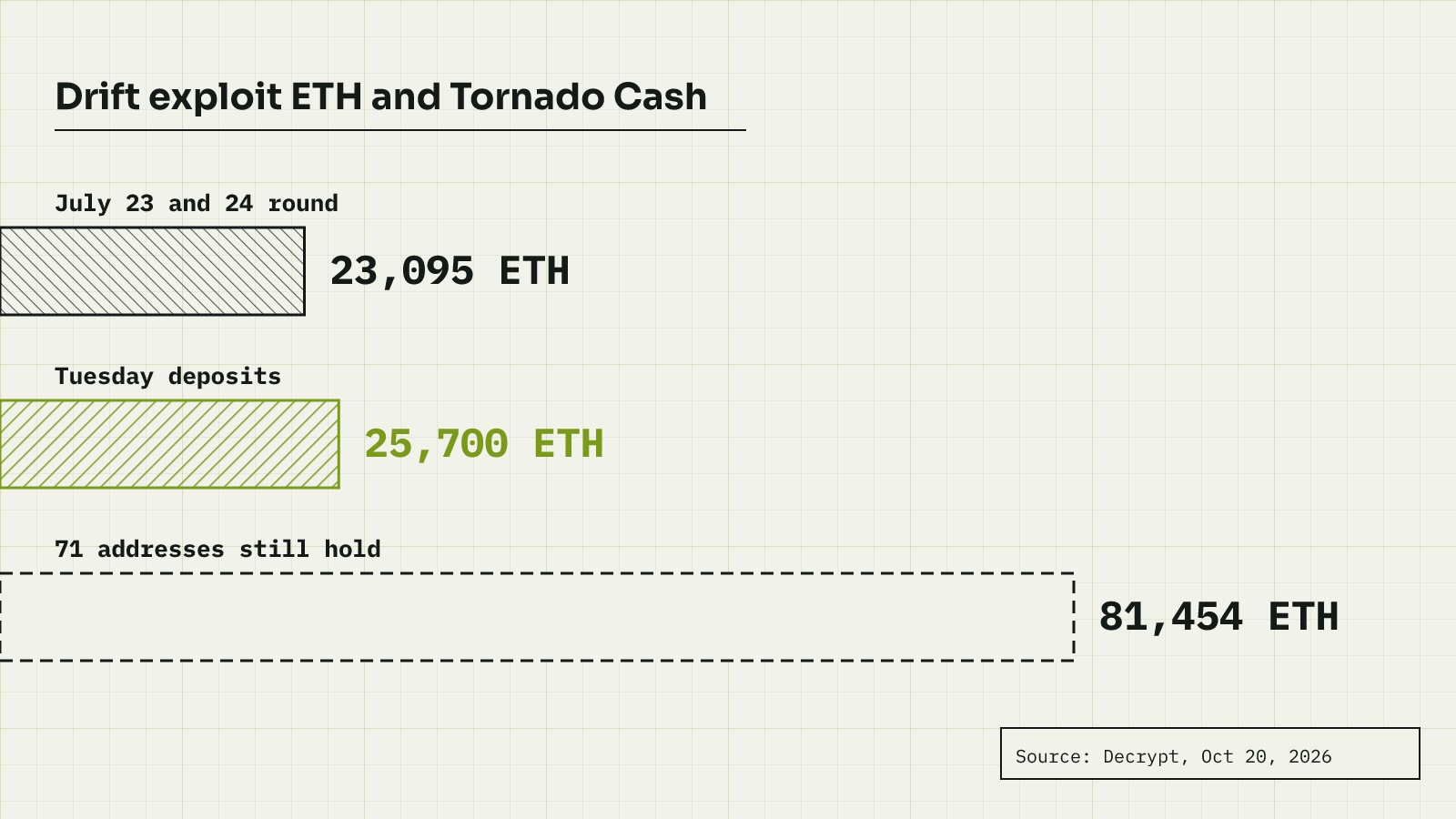
Wallets tied to the April exploit of Drift Protocol moved 25,700 ETH, valued near $61.56 million, into the Tornado Cash mixer on Tuesday, Decrypt reported. The whole burst took about two hours. This article looks at how anyone can follow those funds on a public ledger, and at the exact point where the trail stops being readable.
What the transfers show
According to Decrypt, the attacker addresses had been quiet for roughly two months before Tuesday. Then the ETH went in lots of 100 ETH, each worth about $237,800, mixed with smaller 10 ETH pieces. The data came from Arkham Intelligence, a firm that labels and groups blockchain addresses.
This was not the first round. On July 23 and 24, a wallet tagged Drift Exploiter 4 sent roughly 23,095 ETH, then near $44.4 million, to the same mixer. Arkham still counts 81,454 ETH, roughly $198.58 million at current prices, across the 71 addresses it links to the attacker, plus about $561.6K in other assets such as USDT, USDC, Solana and USDY.
The money started on a different chain. The exploit hit Drift vaults on Solana on April 1. The attacker gained admin rights, listed a fake token and borrowed real liquidity against it. Drift's own tally of the loss is $295.7 million. The two biggest pieces were $159.3 million in JLP, a Jupiter liquidity token, plus $71.4 million in USDC. Most of it was later swapped and bridged over to Ethereum, where the mixing took place.
Is crypto traceable? The method behind the trail
Yes, up to a point. Every transfer on Ethereum or Solana is recorded in public, with the sending address, the receiving address, the amount and the time. Nobody needs special access to see that a given address sent 100 ETH to a Tornado Cash contract. What is hidden is the person behind the address.
Tracing firms close part of that gap with labels and clustering. Clustering means grouping addresses that probably share one owner, for example because funds flow between them. Arkham's entity page for the Drift attacker is such a cluster of 71 addresses, and transfer records for such a cluster are what show new deposits.
The mixer is where the method hits a wall. Tornado Cash uses fixed deposit pools, and that explains the neat 100 ETH and 10 ETH lots. Each deposit in a pool looks the same as every other deposit of that size. Later, the owner can withdraw to a brand-new address. On-chain, you can see coins go into the pool and coins come out, but the link between a specific deposit and a specific withdrawal is cut.
Limits: where the on-chain picture can mislead
The Drift case shows both the strength and the blind spots of on-chain analysis. A few cautions apply to every figure above.
- Clusters are estimates. The 71 addresses are Arkham's grouping, not a fact written on the chain, and a cluster can miss wallets or include the wrong ones.
- Dollar values move. The $61.56 million and $198.58 million figures use ETH prices at the time of reporting, so the same coins can be worth very different amounts later.
- Portfolio views can look odd. Arkham still shows a single Fartcoin, worth about 15 cents, in the exploiter's holdings, while Drift says $4.1 million in Fartcoin was taken. A balance tells you what sits in a wallet now, not what passed through it.
- Attribution does not come from the ledger. Drift said in June that Mandiant, a forensics firm, linked the hack to UNC6862, a North Korean threat group. A ledger records addresses, not names, so a link like that needs evidence from outside it.
The social side is invisible too. Drift said in April that the attackers spent six months posing as a quant trading firm and deposited $1 million to build trust.
What victims are getting back
Drift now runs a relaunched exchange called Velocity. On Oct. 1 it opened claims for DFX recovery tokens, issuing one per verified USDT lost, about 299.5 million tokens in all. The recovery pool started with about 3.1 million USDT, which meant the first claims returned roughly 0.0104 USDT for each token, about a penny on the dollar, according to Decrypt.
Funding for the pool comes from three places. It gets a share of Velocity's daily net protocol revenue, set between 60% and 90% and rising as revenue grows. Tether has pledged up to 127.5 million USDT for the relaunch and for recovery. And whatever stolen money comes back, whether by freezes, the bounty or law enforcement, is added too.
What to watch next
The 81,454 ETH still sitting in the attacker cluster is the main thing to track. More fixed-size deposits to Tornado Cash would show up in the same transfer data. Withdrawals are harder, because they land at fresh addresses with no history. Analysts may use timing or amount patterns to guess which ones belong to the attacker, but those are probabilities, not proof. Treat any claim that stolen crypto was fully traced with care, and ask which part came from the ledger and which from inference.
Sources
- Decrypt, 20 Oct 2026
Drafted by AI from the research and on-chain sources listed, then published automatically once checks confirmed the figures against those sources and found no copied text. Not reviewed by a person. Metrics are explained, never turned into price calls.