News analysis ·
Binance's 26,000-Address Freeze List: How It Is Built
A court order lets Binance flag 26,000 wallets tied to its hack. How tracers build such a list on-chain, and where the method runs out.
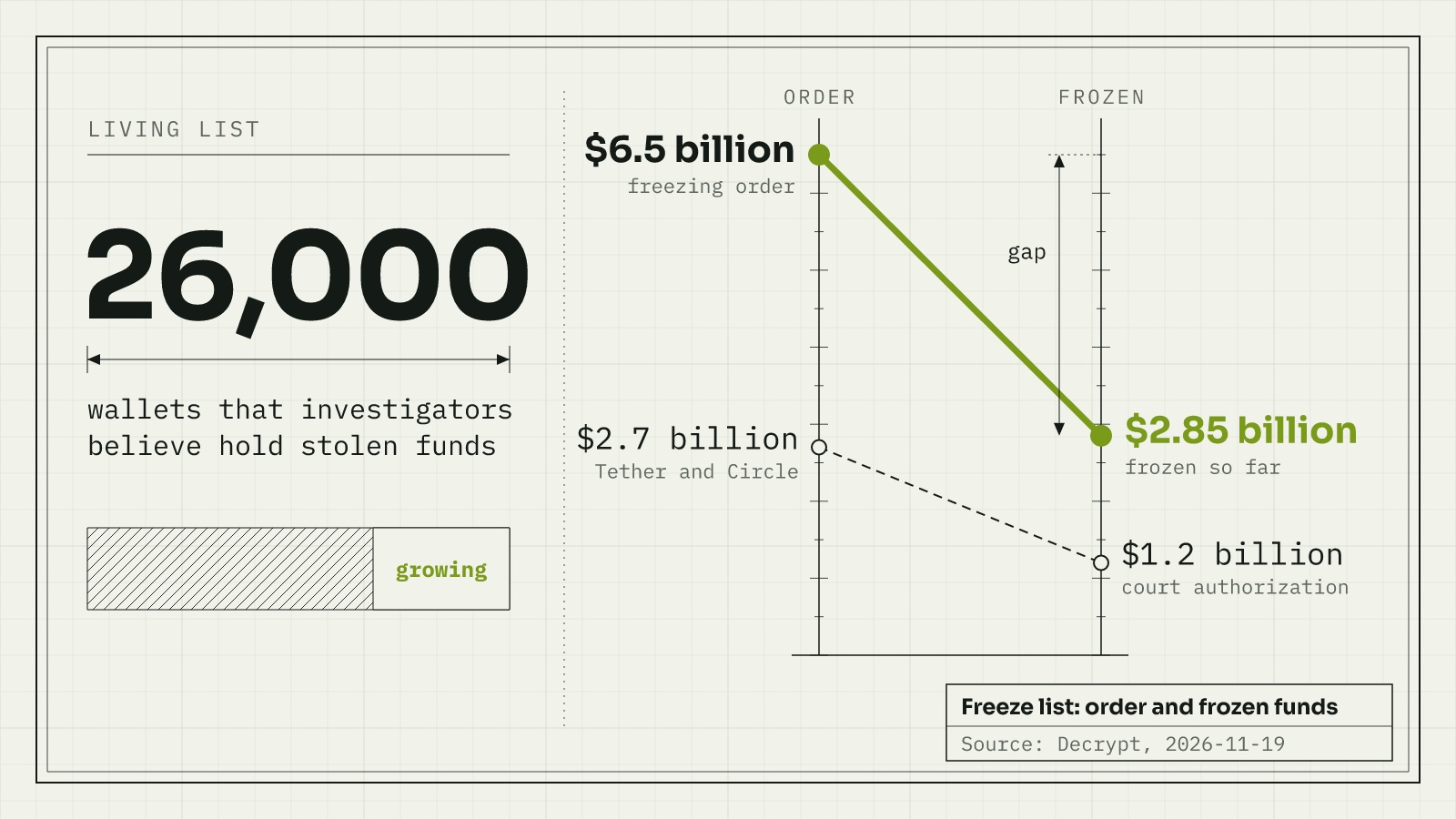
Binance has won a worldwide freezing order worth $6.5 billion against the unknown attackers behind last month's hack, Decrypt reported. The order comes with a continually updated list of 26,000 wallets that investigators believe hold stolen funds. This article looks at how a list like that is built from public blockchain data, and why it can never be complete.
A court order that points at addresses
According to Decrypt, citing City AM, a court of the Abu Dhabi Global Market (ADGM) issued the injunction, and Gibson Dunn, the law firm acting for Binance, confirmed it. The order targets people nobody has named. What it can name is wallets.
Gibson Dunn partner Kendall Day said the order may be served directly on the blockchain, which is unusual. Market participants will be told about the list of 26,000 wallets so that, in Day's words, it allows "those assets to be frozen rapidly even as they are laundered at pace". Binance also obtained proprietary injunctions and delivery-up orders, some of which cover holders of frozen assets who are not accused of any wrongdoing.
The FBI has blamed the October 29 attack on TraderTraitor, a North Korea-linked crew; North Korea denies involvement. Bloomberg reported that the attackers got in after an engineer fell for a phishing lure dressed up as a job offer. Binance says it covered the full $6.3 billion of affected customer assets from its own funds.
Is a crypto wallet traceable? The method behind the list
Yes, in one sense. Every transfer on a public blockchain is recorded, so anyone can follow coins from one address to the next. What the ledger does not show is who controls an address. Tracing firms fill that gap with attribution: labels that link addresses to exchanges, services or known actors, collected over years.
Chainalysis described how its investigators worked this case using Chain, a new AI workspace the firm built. The company says it draws on more than 12 years of attribution data. A freeze list is the output of steps like these:
- Start from the addresses that received funds straight from the victim, then follow each outgoing transfer.
- When funds cross a bridge, a service that moves tokens between blockchains, match the deposit on one chain to the release on the other. Chainalysis says its team did this to follow money between chains.
- Spot repeat habits. Chainalysis saw large sums split into smaller pieces, then pushed through DeFi swap protocols that trade one token for another.
- Turn each habit into a routine. In one flow the attackers swapped between stablecoins again and again, and investigators automated the steps of following each swap and its recipient.
Each address that the trail reaches is added to the list. Because the attackers keep moving funds, the list has to keep growing, which is why Day described it as continually updated.
Why speed matters as much as accuracy
A label on its own freezes nothing. Funds stop only when a party that controls them acts, such as an exchange or a stablecoin issuer that can block tokens. Bloomberg counts about $2.85 billion of hack-linked funds frozen so far, with Ripple and World Liberty Financial among those that acted, Decrypt reported. Tether and Circle froze $2.7 billion soon after the theft, and the Justice Department later got court authorization covering $1.2 billion of that sum.
Chainalysis makes the point that following automated laundering one wallet at a time by hand cannot keep up with attackers moving billions. The legal order and the automated tracing aim at the same weak spot: the gap between when coins move and when someone can stop them.
Limits: where on-chain tracing runs out
A list of 26,000 addresses sounds precise. It is still an estimate built on inference, and readers should treat it that way.
- Attribution is a judgement. Linking two addresses to one owner relies on patterns and past labels, and a wrong link can catch an innocent wallet. The order already reaches holders who face no accusation.
- Bridges and swaps break the trail. Matching a deposit on one chain to a release on another is a matching exercise, not proof. Where many transfers look alike, a match is harder to be sure of.
- Scale outruns people. Decrypt reported the remaining funds were laundered through thousands of wallets on several chains, and Chainalysis says the funds spread across tens of thousands of addresses.
- A freeze needs a gatekeeper. Coins sitting in a wallet nobody can block stay visible on the ledger but out of reach.
What to watch next
Decrypt reported that hack-linked wallets started moving Ethereum again this week after two quiet weeks. Fresh movement is when a living list either keeps pace or falls behind. Watch whether new addresses are added as funds move, whether more exchanges and issuers act on the list, and how the courts treat frozen assets held by parties who did nothing wrong.
Sources
- Decrypt, 19 Nov 2026
- Chainalysis, 19 Nov 2026
Drafted by AI from the research and on-chain sources listed, then published automatically once checks confirmed the figures against those sources and found no copied text. Not reviewed by a person. Metrics are explained, never turned into price calls.