News analysis ·
On-Chain Analysis of the $5.57 Billion Binance Exploit
Public ledger entries track how $5.57B left Binance hot wallets, revealing DEX swaps, stablecoin freezes, and the limits of on-chain tracing.
Blockchain records show that at least $5.57 billion in digital assets departed Binance hot wallets across three networks on October 29, 2026. Public transaction data reveals how the attacker moved funds through decentralized exchanges while stablecoin issuers raced to freeze assets. This article traces the on-chain path of the exploit and examines what ledger data can and cannot uncover during a large-scale breach.
The $5.57 Billion Multi-Chain Drain
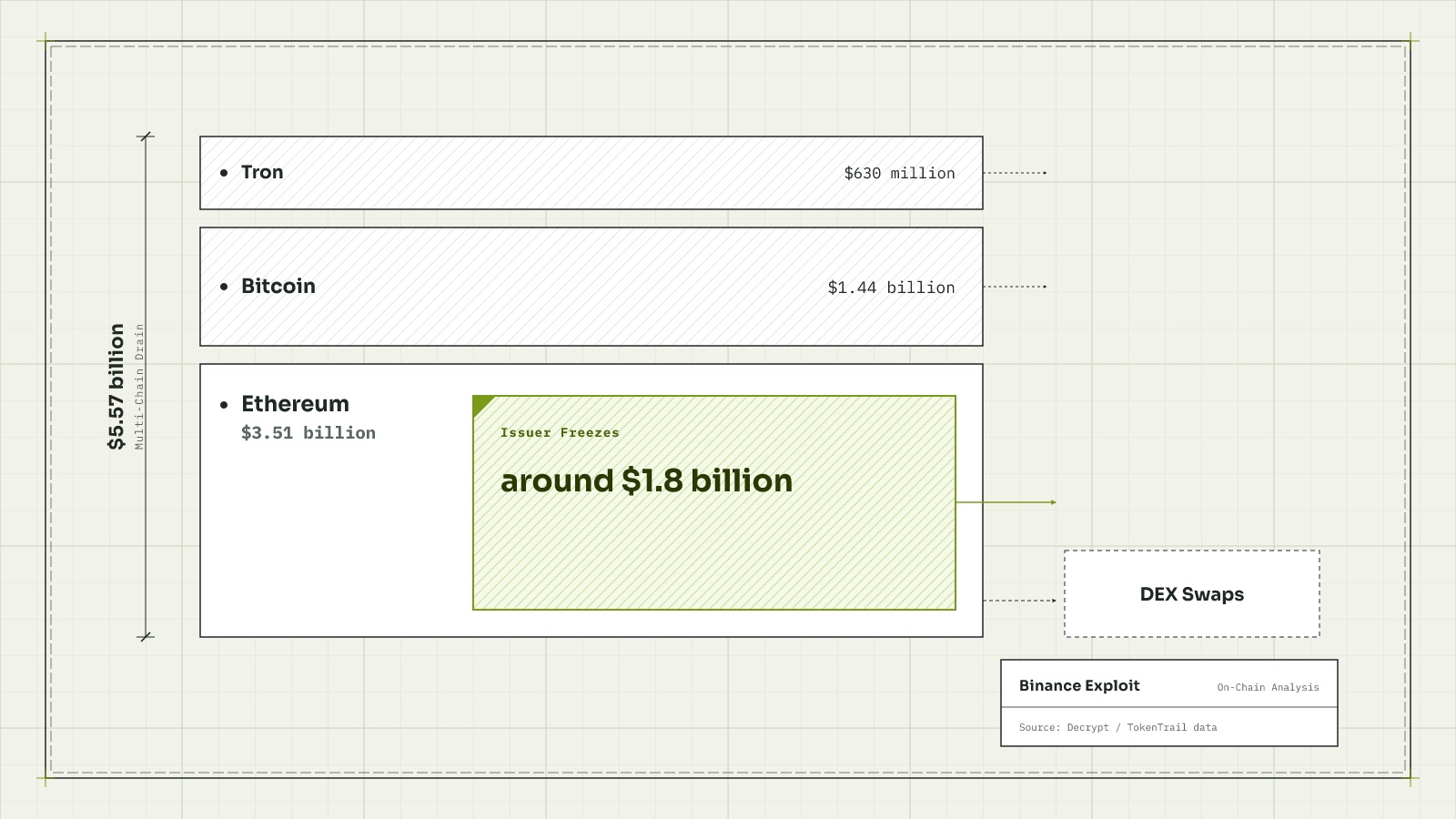
According to reports by Decrypt, the exploit drained assets across Ethereum, Tron, and Bitcoin infrastructure. Ethereum absorbed the largest loss at $3.51 billion. The Bitcoin network recorded an outflow of 18,270 Bitcoin valued at $1.44 billion, while Tron accounted for $630 million of the missing assets.
On-chain forensic data showed preparation minutes before the transfer began. Exactly three minutes prior to the main outflow, an address funded through Tornado Cash submitted an EIP-7702 delegation to Binance hot wallet infrastructure. EIP-7702 is an Ethereum standard that allows a standard externally owned account to temporarily designate code execution to a smart contract.
The initial Ethereum transaction took place at 20:24 UTC. That single transaction moved 167,464 ETH alongside 63 separate token balances to a newly deployed address. Among those balances was 1.615 billion USDT. Binance stated that internal security teams are investigating the incident and noted that user balances have not been confirmed as impacted.
What On-Chain Analysis Reveals About the DEX Swaps
On-chain analysis is the practice of reading public blockchain ledgers to inspect transaction histories, smart contract calls, and wallet balances. In this incident, on-chain analysis shows that the attacker immediately used decentralized finance protocols to trade volatile tokens and stablecoins for native ether. This allowed the actor to transfer value without relying on centralized order books.
Etherscan tracking identified 10 attacker-controlled wallets actively trading blacklisted stablecoins for Ethereum on decentralized venues to evade token-level controls. Automated market maker contracts on Uniswap routed several massive conversions. At 20:34 UTC, Uniswap contracts routed 20,940 ETH worth $45.58 Million to one intermediary wallet. Another swap delivered 3,552 ETH at 20:47 UTC.
Subsequent Uniswap transactions distributed approximately 18,085 ETH valued around $41 million and about 16,498 ETH worth $37.5 million across auxiliary addresses. The attacker also targeted newer assets, swapping 36 million RLUSD into 15,439 ETH before issuers could halt the token contract.
Issuer Freezes and Protocol Pauses
Centralized stablecoins contain administrative smart contract functions that allow issuers to blacklist addresses. Tether added the primary drain address to its blacklist, freezing 975.1 million USDT before it could be moved. Circle followed by blacklisting the same wallet at 21:04 UTC, locking 823 million USDC and pushing the combined frozen total to around $1.8 billion.
As reported by Decrypt, Jeremy Allaire, CEO of Circle, confirmed the action: "In coordination with law enforcement, we have frozen more than 800M USDC associated with the incident and will continue supporting the investigation."
Ripple also executed contract freezes on approximately $200 million in affected assets. However, the attacker managed to route funds through decentralized lending markets before all controls took effect. Between 20:57 and 21:01 UTC, an exploiter wallet supplied $10 million and $50 million in USDT into Aave to borrow 3,271 ETH and 16,491 ETH.
To contain risk, Aave halted its V3 Ethereum mainnet markets to stop additional borrowing. Solana-based Kamino also paused borrowing across SOL/BTC markets as a precaution against cross-market contagion.
Tracing Intermediary Wallets and Fund Aggregation
Tracing stolen funds requires mapping the parent transactions, internal contract calls, and destination wallets. Block explorers record each step as an immutable state update. By reviewing these logs, researchers follow how single large transfers split into complex sub-networks.
Despite automated blacklists, the exploiter systematically concentrated funds into secondary holding addresses. By 22:03 UTC, an address designated Exploiter 8 held 195,460 ETH. Another wallet accumulated 57,891.77 ETH after four intermediary transfers conducted across 28 minutes. These hops complicate monitoring by separating the original drained wallet from the final resting addresses.
Limits of On-Chain Tracing in Large Exploits
While public ledgers provide clear visibility into address balances and transaction timestamps, on-chain tracing has operational limits when dealing with rapid multi-chain exploits:
- Administrative freezes only work on smart contract tokens with built-in blacklist logic; native base-layer coins like ETH and BTC cannot be paused or frozen by any issuer.
- Fast execution on decentralized automated market makers allows funds to convert into native assets before issuers or security teams can submit freeze transactions.
- Public addresses show transaction amounts and timestamps, but they do not reveal off-chain identity, internal server access methods, or the real-world actors operating the private keys.
What to Watch Next
Investigators will continue monitoring the cluster of attacker wallets, including Exploiter 8, to see if the gathered ETH moves toward cross-chain bridges or mixing protocols. Market participants will also watch whether frozen stablecoin balances can be legally recovered or reissued, and what Binance's ongoing security investigation reveals about the initial EIP-7702 delegation.
Sources
Drafted by AI from the research and on-chain sources listed, then published automatically once checks confirmed the figures against those sources and found no copied text. Not reviewed by a person. Metrics are explained, never turned into price calls.